The Future of Logistics Is Post Carbon
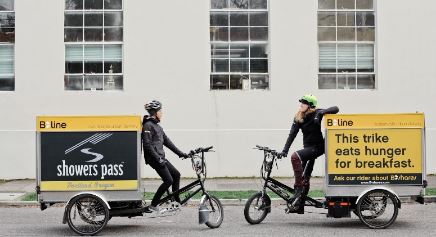
Moving goods and people from place to place in a carbon constrained future will be dependent on sailing vessels, hybrid/fossil free electric ships, and people powered transport for first and last mile logistics.
Latest News

Sail Freight Business Handbook Published
The Sail Freight Business Handbook was compiled for the Center for Post Carbon Logistics (Center) by a team of three Sustainable Innovation MBA (SI-MBA) graduates from the University of Vermont Grossman School of Business (UVM GSB). It has been designed to provide readers with the fundamental business analysis and route identification tools to bring the Center’s goal of increasing, year-round near-zero-emission coastal maritime trade in the United States. By covering the fundamentals of business logic, financial analysis, carbon emissions, and route selection criteria, this report gives the foundation for building a near-zero-emission coastal short sea shipping fleet in the Northeast US. A YouTube video of the presentation is available here.
The Sail Freight Business Handbook. It is a revolutionary tool, designed to expand year-round, near-zero-emission coastal maritime trade in the United States by using wind propulsion. The Handbook provides entrepreneurs with an open source how-to guide to start a short sea sail freight shipping fleet in the Northeast US. Covering the essentials of business logic, financial analysis, carbon emissions, and route selection criteria, the Handbook is a comprehensive manual for anyone preparing to start a regional near-zero emission maritime business.
Give Today to Protect Tomorrow
Your support empowers local communities to transition away from fossil fuels and build sustainable, post-carbon logistics.
Mission:
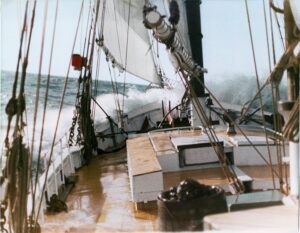
The Mission of The Center for Post Carbon Logistics is to research and assist in the implementation of appropriate post carbon maritime technology needed to keep commerce and transportation viable by responding to the interrelated connectivity, communication, equity, economic, ecological, and energy crises of the 21st Century.
Vision:
We envision a world where resilient, re-localized communities thrive—connected through sustainable, post-carbon transport and logistics systems. As the impacts of climate change intensify, building networks that prioritize local production, reduce carbon emissions, and strengthen community connections is no longer just an ideal—it’s essential. We are committed to shaping a future where our communities are prepared, adaptable, and empowered, moving goods and people efficiently without compromising the planet.
The Urgency of Now
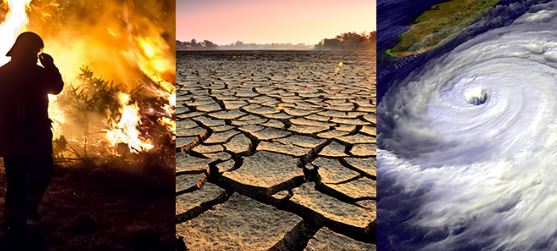
The path we’re on is unsustainable. Continuing with “business as usual” leads to a future defined by catastrophic food and energy shortages, breakdowns in transportation, failing infrastructure, rising sea levels, financial collapse, and the social unrest that follows. As the climate crisis accelerates, we must act with purpose and urgency to build resilient systems that prioritize local solutions and sustainable practices.
Possible response strategies:
- Denial/Blissful Ignorance: Ignoring the warning signs and continuing as usual.
- Last One Standing: Reacting with anger, blame, and conflict over dwindling resources.
- Power Down: Accepting reality, adapting, and reducing our consumption.
- Building Lifeboats: Preparing local communities to be resilient and self-sufficient in the face of global economic and environmental collapse.
We choose to build lifeboats—local solutions rooted in community and resilience. We focus on preserving knowledge, advocating for sustainable practices, and training individuals to create a more adaptable future.
Our Initiatives:
Preserve Knowledge: The Center serves as a living archive of traditional skills and practical tools needed in a post-carbon world. Our library, data repository, and collection of pre- and post-carbon technologies foster the restoration and reuse of vital, time-tested methods.
Movement Building and Advocacy: We champion maritime and first- and last-mile technologies essential for carbon-free transport. We advocate for low-carbon shipping practices and support businesses and organizations already making progress in this field.
We also advocate for the creation and maintenance of working waterfronts in small to mid-sized ports throughout the Hudson Valley, NY Harbor, Canals, and the Atlantic Coast. We envision a transition driven by community spirit—a collective effort to build sustainable, interconnected local economies. As Rob Hopkins articulated in The Power of Just Doing Stuff, we believe in the practical, hands-on work of building the future we need.
Training Individuals and Organizations: We collaborate with partners to offer practical training and workshops—bridging theory and hands-on experience. Our space is a hub where professionals and apprentices learn the skills necessary to build and sustain local, post-carbon systems.
We also host regional, national, and international conferences on sustainable logistics, traditional skills, and sail freight, fostering knowledge sharing and collaboration.
Through these efforts, we equip communities to transition from a fossil-fuel economy to a “restorative economy”—one that is human-scaled, rooted in local energy solutions, and centered around sustainable, practical, and actionable change.
Now is the time to take purposeful, local action to secure a resilient, post-carbon tomorrow.
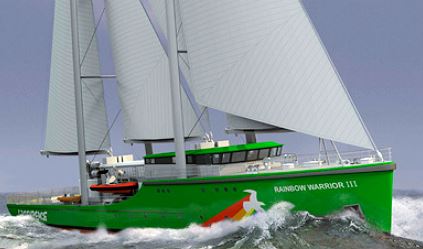
Future Proof Ships,
Liberty from Fossil Fuel
Locally built, from locally sourced and recycled materials, crewed with locally trained mariners, home ported along the Hudson, the Harbor, and the canals, carrying locally grown, locally processed, and locally manufactured goods – with liberty from fossil fuels, these future proof ships will be a positive disruption to the status quo.
Future Proof Ships-Brutally Simple
Our four pillars of Design, R&D, Finance, and Build work together as a holistic solution by integrating innovative concepts, practical experimentation, sustainable funding strategies, and hands-on implementation to create resilient, low-carbon maritime logistics systems.


