Category: CPCL Publications

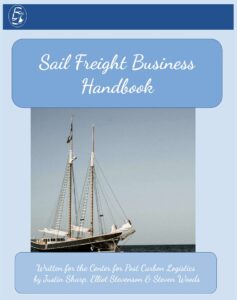
  • Sail Freight Business Handbook Published

    The Sail Freight Business Handbook Summary

    A Publication of the Center for Post Carbon Logistics, Inc.

    The Sail Freight Business Handbook was researched and written for the Center for Post Carbon Logistics (CPCL) by a team of three Sustainable Innovation MBA (SI-MBA) graduates from the University of Vermont Grossman School of Business (UVM GSB). It has been designed to provide entrepreneurs and advocates with the fundamental business analysis and route identification tools to bring the Center’s goal of increasing year-round, near-zero-emission coastal maritime trade in the United States. 

    Covering the fundamentals of business logic, financial analysis, carbon emissions, and route selection criteria, this report provides a foundation for building a near-zero-emission short sea shipping fleet in the coastal Northeast United States.  A YouTube video of the presentation is available here.

    The study concludes that using sailing vessels under 500 Gross Tons (GT) is the optimal approach for the US sail freight industry, with a focus on local routes where a cost leader or cost stabilization strategy can be used to compete with trucking.  A business-to-business (B2B) sales approach is recommended, as opposed to competing as an import-export business with a sailboat component like the predominant European model for sail freight. Due to the range limitations and economic viability for small sail freighters, these routes will be under 150 miles initially, except where trucking rates are exceptionally high.

    The sail freight business must be interoperable with conventional and sustainable transportation on land to reduce the cost to customers of switching freight modes. Year-round packet or liner routes between designated ports are favored, alongside long-term contracts for cargo where possible to optimize new customer acquisitions and increase retention.

    Tramping does not appear to be economically viable at this time in coastal trade and is ruled out of scope. Despite their prevalence in other sail freight models, passenger service and paying trainees are excluded from this report’s model. The regulatory burden for taking on passengers adds unnecessary complexity and expense to the business operations. Trainees will be salaried employees, not paying guests, if the industry is to grow rapidly and be taken seriously. Routes which could not compete without these additional revenue streams were judged non-competitive in our analysis and ruled out of scope.

    This report focuses on sail freight in US Territorial waters and falls under US regulations and requirements that may not be applicable to vessels engaged in international trade or based in other jurisdictions. While the applicability of certain regulations will be examined for each new route, the remainder of this report’s findings; basic business logic, range calculations, and other elements may be translated to other US regions without significant modification. For those looking to engage in foreign voyages, there are a wide range of additional regulations that must be considered.

    The Handbook concludes that sail freight can be competitive in the transportation industry in the Northeast US, so long as it is technically compatible with existing transportation systems. Route selection, capacity matching, and a strategy appropriate to the economic and geographic environment of a route are critical to success. Having multiple routes of varying profitability all under one umbrella company to cross-subsidize marginal routes is also recommended as a way of rapidly expanding a regional sail freight network.  To read a PDF of the entire report click here.   

    To support the work of the Center for Post Carbon Logistics, the  publication and wide distribution of the Sail Freight Business Handbook please click here.


  • Sail Freight Second Edition

    Sail Freight Second Edition

    A publication of:

    The Center for Post Carbon Logistics

    Sail Freight Second Edition

    Editor Steven Woods

    Copywrite 2023 The Center for Post Carbon Logistics

    This work is licensed under a Creative Commons
    Attribution-NonCommercial-NoDerivatives 4.0 International License.

    This handbook is not a comprehensive guide to Sail Freight
    operations, but simply a collection of experience gained recently
    during the Sail Freight Revival. It is hoped that this guide will aid in
    understanding the functioning of sail freight operations, but relies on
    perspective sail freight operators to be experienced sailors. The advice
    in this work does not constitute an exhaustive or direct set of
    procedures, but points the way to developing your own.
    No part of this manual can be used directly without adaptation to
    local circumstances, and does not constitute legal, business, investment, or financial advice.

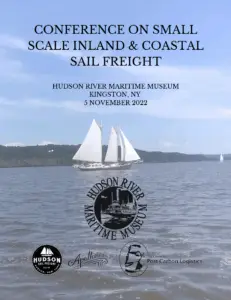
  • Confrence on Small Scale Inland & Coastal Sail Freight 2022

    Confrence on Small Scale Inland & Coastal Sail Freight 2022

    A publication of:

    The Center for Post Carbon Logistics

  • Rondout Riverport 2040

    A publication of:

    The Center for Post Carbon Logistics

    Rondout Riverport 2040
    © Andrew Willner 2022

    This work is licensed under a Creative Commons. Attribution-NonCommercial-NoDerivatives 4.0 International License.

    Rondout past and future

    This work does not constitute an exhaustive or direct set of procedures, but points the way to developing your own plans for resilient small ports. No part of this publication can be used directly without adaptation to local circumstances, and does not constitute legal, business, investment, or financial advice.

    Rondout Riverport 2040 proposes a pragmatic and prosperous vision for the near future with a transformed port, boasting a shore lined with leading-edge and heritage maritime commerce that profit and engage while allowing for an equitable transition beyond fossil fuels.

    Rondout Riverport will offer more capacity, be significantly more compact, and more resilient than the current patchwork of land uses found on today’s waterfront. The mission of tomorrow’s port is the post carbon maritime transport of goods and people up and down the Hudson River and beyond. Riverport is designed to attract shipping, distribution, commerce, food processing, and craft businesses. The result: a regenerative working waterfront — a gateway to the Hudson Valley and world.

    The port’s versatility will depend on the linking of its economic opportunities with environmental restoration, sustainable commerce, and training centers. This multi-generational project will also be a source of inspiration for broader long-term action on climate change.

  • The Sail Freighter Handbook

    The Sail Freighter Handbook

    A publication of:

    The Center for Post Carbon Logistics

    The Sail Freighter Handbook
    © Steven Woods 2022

    This work is licensed under a Creative Commons
    Attribution-NonCommercial-NoDerivatives 4.0 International License.

    This handbook is not a comprehensive guide to Sail Freight
    operations, but simply a collection of experience gained recently
    during the Sail Freight Revival. It is hoped that this guide will aid in
    understanding the functioning of sail freight operations, but relies on
    perspective sail freight operators to be experienced sailors. The advice
    in this work does not constitute an exhaustive or direct set of
    procedures, but points the way to developing your own.
    No part of this manual can be used directly without adaptation to
    local circumstances, and does not constitute legal, business, investment, or financial advice.

    Title Page Image courtesy of the University of Washington Freshwater and Marine Image Bank.

    Introduction And Scope

    This small book isn’t designed to be a complete manual of
    everything you need to know about Sail Freight: That would be a
    volume of several gross register tons, and completely unreadable.
    Instead, this is designed as an introductory How-To of the practical
    elements of Sail Freight. Once you have started to understand the
    regulations, practicalities, and the basics of navigation, this volume
    will begin to be useful. Hopefully, this is the tool you read between
    understanding the theory and buying a boat, to clear up the otherwise
    difficult portions of making a sail freight business function.
    When looking at Sail Freight, just knowing how to sail isn’t
    enough. You have to know how to get cargo back and forth to the
    docks, how to recruit cargos, be your own broker, and more.
    Understanding Coast Guard and state regulations is critical, alongside
    many other practical concerns you’ll find mentioned in this booklet.
    This tool is designed to help guide you through the practical decisions
    necessary to be successful, and isn’t going to help you learn to sail, or
    handle cargo, or other challenges. While this may point out gaps
    which need to be filled in your knowledge, it is hoped that closing
    those gaps before you begin will save a lot of headache, money, and
    (possibly) lives, in the long term.

    https://postcarbonlogistics.org/wordpress/wp-content/uploads/2022/07/Sail-Freighter-Handbook-Google-Docs.pdf