A Blog Post by Steven Woods. Mr. Woods earned his master’s degree in Resilient and Sustainable Communities at Prescott College in 2021, with an undergraduate degree in History from LeMoyne College. He has worked in museums for over 20 years and is making a career transition to the sustainability field after 6 years in the US Airforce. He is presently the Solaris Coordinator at the Hudson River Maritime Museum.
I’m willing to bet a lot of people clicked this article thinking something along the lines of “How about ‘Towards Hiring A Proofreader, Eh?!’” Despite this, the title is accurate: The Food Movement lacks any real vision of how food will move in future from the farm gate to the citizen’s fridge. I am very much talking about a social movement concerned with the physical movement of food.
We could also call such a movement by other names: “Tucker Transit To-Do,” “Respect For Refreshment Relocation,” “Comestible Conduct Concern,” “Victual Voyage Verification,” and “The Food Flow Front” were all suggested to friends before I was summarily kicked out of their house. While “Whence The Vittles?!” was a personal favorite, it seems these are mostly just good ways to make enemies and alienate people while not getting your point across in a helpful way. Thus, we are left with the boring but utilitarian name of The Food Movement Movement.
There are a lot of studies out there about regional food self sufficiency, some dating from the 19th century, and others from just a few years ago. The topic of food sovereignty has been a matter of debate since the 17th century, and usually comes to the fore during and after armed conflicts and other crises which might result in embargos or other interruptions to the food supply, such as Brexit quite recently. Agriculture and food security have long been considered matters of national security and tools of foreign policy, and in war many blockades specifically target food movement into and within enemy nations as a way of inflicting losses and destroying the enemy’s will to continue the conflict..
Far fewer studies actually touch upon how food is supposed to move between its points of origin and consumption within a peacetime food system model. Even fewer touch upon how this can be done at the necessary scale in a post-carbon future.
How food was, is, or will need to be carried over land and sea through the use of self-propelled vehicles, trailers, barges, carts, pack animals, ships, or human powered systems such as bicycles is chronically under studied. A great historical study of this overlooked element of food systems is Walter Hedden’s book “How great cities are fed” from 1929. Without this transportation, food goes to waste and people starve. It is simply impossible for New Englanders to eat food which is sitting in crates on a Texas, Florida, Kansas, or California farm table for lack of transportation capacity. As a result, it is difficult to overcomplicate or underestimate the impact of insufficient transport capabilities on any socio-alimentary system.
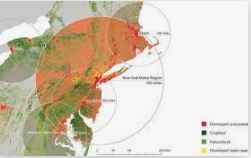
New York City Foodshed
With a carbon-constrained future rapidly approaching and demanding significant changes to transportation habits, this issue is of paramount importance. Unfortunately, it is routinely ignored in food system visions, which are normally published without direct and detailed attention to the distance and means by which food will be transported. Take New England, for example: A New England Food Vision by Food Solutions New England hopes to expand agriculture so half of New England’s food is produced within the region by 2060. While laudable and achievable, this publication doesn’t tell us how literally tens of thousands of tons of food per day will arrive in New England from elsewhere, all year round. The study simply assumes there are sufficient transport resources which are independent of petroleum fuel supplies, will not raise the cost of imported food beyond the reach of citizens, and doesn’t rely on similarly vulnerable, scarce, and unpredictable renewable electricity sources. It also expects petroleum-based paved infrastructure, tires, and other supplies underpinning our current transportation system to continue existing in sufficiently decent condition to carry these millions of daily ton-miles across the region and the continent.
None of this should be taken for granted, but it is easy to understand why it is forgotten in our current economy and era of easy access to energy. With cheap fossil fuels, low shipping costs, and a probably misplaced faith in miracle technologies, we as a culture and a nation have a tendency to get carried away with the thought of our current transport system existing forever. It is honestly difficult to imagine anything else, even when you put your mind to it.
Large Sail Freight Vessel
So, the need clearly exists for a Food Movement Movement. But how would it operate? What vehicle could possibly provide New England’s massive import requirements with oil- and electricity-independent, renewable, reliable, and emissions-free transportation without the need for paved infrastructure? The answer isn’t terribly difficult to find for those who have studied the region’s history: Sailing Vessels.
Visit any one of the dozens of Maritime Museums in New England, and you can see there is plenty of tradition, knowledge, and capacity to supply New England’s food imports by sail freight. By my calculations (Pages 74-78 Here), a mere 3,000 ships and 18,000 sailors would be able to meet this demand with room to spare for a small amount of delays, time off, and some commodities I hadn’t included in the original math. This is with small vessels, too: A ship of only 111.5 tons cargo capacity, with a crew of 6.5 sailors was used as the rule.
Sail Training Vessel with Cadets
It is eminently possible to build, launch, and crew these vessels over the next 40 years, while creating tens of thousands of jobs. It is also more than possible to use existing training infrastructure from organizations such as Tall Ships America, US Sailing, and The American Sailing Association to ensure a sufficient pool of skilled windjammer sailors are at hand to take them over the seas.
This fleet only supplies the import needs of New England. The Coastal Trade in New England is prime territory for exploitation by enterprising Yankee Sailors, due to the historical settlement patterns of the region. Dozens of small ports and harbors can become points of carbon free shipping within the region, as was seen with the Vermont Sail Freight Project and Maine Sail Freight. These projects have shown the way to a Slow Food Movement Movement, though some brokerages and other infrastructure will need to be built to support this type of transportation. This type of business pattern change is a minor thing in all reality, and can be accomplished if we set some Yankee determination and ingenuity to work on it.
Tres Hombres Sail Freight Vessel
Far larger areas than just New England can be served by Sail Freight: Cities and towns along all four of the USA’s coastlines (Atlantic, Pacific, Gulf of Mexico, and Great Lakes) can benefit from Sail Freight, as can the massive regions of the midwest served by our over 12,000 miles of inland waterways. As with any other such infrastructure, ports, harbors, anchorages, channels, locks, dams, sluces, dry docks, weirs, inclined planes, and shipyards must be maintained every year, fully funded, and cared for. However, unlike other infrastructure investments, they are long term, lasting up to or in excess of 50 years for locks, and support carbon free shipping in the place of resource-intensive gas, diesel, and electric powered vehicles.
As we think of Slow Food, we should keep in mind the importance of moving that food around the block and around the world as sustainably as it was grown. With a bit of planning, civic involvement, prudence, and forethought, far more than just the slow food movement can benefit from the slow movement of food.
This article is a summary of the Steven Woods’ Master’s Thesis: “Sail Freight Revival: Methods of calculating fleet, cargo, and labor needs for supplying cities by sail.” Master’s Thesis. Prescott College, 2021. The full thesis can be read Here.
Solar Electric USCG Inspected passenger vessel Solaris
Steven Woods earned his master’s degree in Resilient and Sustainable Communities at Prescott College in 2021, with an undergraduate degree in History from LeMoyne College. He has worked in museums for over 20 years and is making a career transition to the sustainability field after 6 years in the US Airforce. He is presently the Solaris Coordinator at the Hudson River Maritime Museum.
Ssil Freight Schooner Apollonia
Sail Freight is an ancient, proven, and fuel-independent means of transportation for both cargo and people. At scale, it could easily provide a means of provisioning cities across the world with food and other essential goods, while avoiding the use of strategic materials such as lithium, cobalt, biofuels, solar panels, electricity, and copper which are needed for the land-based energy transition. The challenge of moving to a sustainable transportation system is of critical importance, and the need to maintain a sufficient transportation capacity for food is literally a matter of life and death.
Sail Freight Vessel Tres Hombres
Sail Freight has gained popularity and visibility as a means of near zero carbon transport, and justifiably so. As complex Sail Freight networks have existed for at least 4,000 years in the Mediterranean, and possibly as long as 40,000 years in the South Pacific, the art of sailing is not new, and does not require complex or energy intensive technologies. Once a sail freight vessel is launched, the carbon emissions from the vessel are nearly zero, and service lives can cover several decades. As 90% of the world’s commerce moves by sea, and modern container ships normally burn over 100 tons of heavy fuel oil per day on their voyages, sail freight seems a good means of cleaning up global commerce.
Until recently, it seems no one has examined the scale at which sail freight must be adopted to fulfill these hopes and aspirations, nor has anyone looked at the auxiliary challenges of adopting sail freight, such as the capacity available to train windjammer sailors, build ships, and so on. Other challenges arise simultaneously to fleet capacity: Food systems and diets must change, warehouses be revived and staffed, superfluous shipping avoided, and foodsheds altered, while regulations change and physical infrastructure needs to be modified. Without a systems view of the whole readoption of sailing freight; any discussion thereof is unlikely to grasp the magnitude of the task at hand.
Black Seal unloading in Brooklyn
The first step in such a process is establishing a level of supply needed in a given city, which in our case with be the New York Metro Area. To survive, the city must have 2.5 kilograms of food per person daily. With a population of some 20,000,000 people, the New York Metro Area needs 50,000 metric tons of food per day, at a minimum, to prevent starvation. This gives us our daily requirement but does not give the full picture. A representative model of the NYMA Foodshed must be established, and the travel times from the food’s origin to destination must be calculated, alongside time for loading and unloading, as well as time for the ship to return to the origin for its next cargo.
The table below gives one such model for the New York Metro Area, at two levels of supply, using relatively small vessels, and illustrates the challenge before us quite well.
As can be seen, even at the lowest possible level of supply, it would require nearly 10,000 ships and 65,000 sailors to supply New York with food, and this without allowing time for crew rest, delays, or ship maintenance. At our current pace of launching Sail Freight Vessels, it would take near 44,500 years to build such a fleet. If we put all the shipyards in the US to work on the problem, however, it could be accomplished in as little as 13 years. While this feat would only be a start, as other cities will need their own fleets, these figures show the scale of the problem we are confronted with, and that it can in fact be solved quickly and effectively.
Of course, ships without trained crews are useless. The time to train windjammer sailors must also be considered. With an average program able to train around 650 sailors in a given year, the number of training program years needed to train the NYMA fleet’s crew requirement would be some 100 years, though with 8 such programs running concurrently this could also be accomplished in less than 15 years. The chart below shows the relationship between training program years and shipyard years and demonstrates that training a sufficient number of sailors will likely take longer than the construction of a sufficient number of vessels for the mission at hand.
sail training vessel
These figures all rely on a “Survey Average Vessel” of 111.25 tons capacity, and 6.5 crew members on average. These would be relatively small vessels, and larger vessels will need fewer of both ships and crew to give the same Fleet Tonnage. It is likely in the beginning of sail freight’s revival that small vessels will be involved, both reclaimed and newly built, which will have larger crew requirements and lower tonnages than the model here portrays. It is worth taking a comprehensive look at the current sail training resources in the US and subsidizing the training of windjammer sailors and captains as soon as practicable.
In the case of Sail Freight, fuel or energy efficiency is not applicable in the same way as with conventional transportation. The appropriate metric of efficiency is “Tons Per Sailor” as the major cost is labor. The higher the tons per sailor, the lower the cost of moving cargo becomes, and the large the vessel, the greater the tons per sailor. Further, this metric is effected by rig, as seen below.
Sloops and Scchooners fore and aft rigs
Through the intelligent choice of rig for specific applications, crew requirements can be brought down somewhat as larger vessels proliferate. Fore-and-Aft rigged vessels such as sloops, schooners, and brigantines generally have a smaller crew and are well suited to the coastal trading which will likely constitute much of a sail freight food movement system. Barks, Ships, and very large schooners will also likely see use on longer routes with far more cargo, but moderately sized crews.
Other challenges are present for reviving sail freight. Without substantial changes bringing the external costs of road and fossil fueled transport into the economic equations through weight-distance, tire, fuel, and carbon taxes, sail freight will remain economically uncompetitive excepting on very long routes with high-value cargos. As the price of fossil fueled transport rises, this competitiveness will even out, and short sea shipping under sail will most likely gain traction in the economic mix.
truck pollution
There are significant benefits to moving to sail freight for climate policy which makes the case for its adoption despite these challenges. It has been calculated that at a minimum, more than 220,000 tons of CO2e could be eliminated from US transportation emissions through supplying the NYMA with food via Sail Freight. This model assumes that all food is brought via 10,000 TEU container ships, which can move some 380 ton-miles on a liter of diesel fuel. Trucking, by comparison, nets only 1.58, while trains can get up to about 118-ton miles per liter of diesel fuel. If the latter number was calculated for trucking emissions instead of conventional maritime transport, it would be some 21 billion liters of diesel fuel and 63,560,087,101 Tons of CO2e avoided annually. This amounts to some 362,000 barrels of oil per day.
pollution from ships
Alongside these benefits, shifting cargo to waterways will reduce congestion, wear, and tear on highway and rail systems, thus likely increasing the overall fuel efficiency of these same systems. Biofuels made from food wastes will be freed for use in supplying cities without nearby port facilities and demands on the grid for electrical power to fuel electric trucks will be lessened. In addition, the number of electric trucks to be built will also decline, making electrification faster and simpler in the long run.
Vermont Sail Freight Ceres
There are other advantages to Sail Freight which are less obvious than the environmental benefits and the challenge of training crews and building ships. For example, small vessels can be built inexpensively and with little needed in the way of facilities. Small ships can be built in the tradition of the Farmer’s Ships of the Aland Islands, which was effectively a combination of bot community supported agriculture and community supported shipping. Ceres of the Vermont Sail Freight Project is an example of just such a vessel, which made several successful voyages from Lake Champlain to New York City for the mere cost of some $20,000. With more advanced designs becoming available, planned for mass production and low cost in the style of the liberty ships of World War Two, these higher-capital ships will be in financial reach of cooperatives all around the four coastlines of the US and abroad.
Schooner Apollonia
This more democratic ownership model for transport, independent of fossil fuels, removes major costs for farmers in rural areas, especially as the cost of fuel and trucking rises. This can have the effect of lowering or stabilizing food prices for citizens while keeping more money moving to farmers and sailors. This is of mutual benefit to both city and countryside, clearly, but also reduces the power of banks and major corporations in both the transportation and food systems.
NYC Foodshed
Despite these benefits, there are many social and cultural adaptations which must be made to adapt to a Sail Freight future. The idea of constantly having fresh produce, in the off-season from 3,000 and more miles away will have to be abandoned. Diets must become more regionalized and localized, and the use of preserved foods instead of fresh in agricultural off seasons will become the rule. With innovative growing techniques, green houses, and other adaptations, there are likely to be small supplies of fresh foods in off seasons, but New York is unlikely to have shiploads of citrus arrive in good condition from Tampa after over a week in transit. Citrus juices, jams, preserves, and other shelf-stable confections will have to take the place of these foods where possible, and processing happen near the point of origin.
Next-day delivery will be impossible, and Just-In-Time delivery systems will be a thing of the past, replaced by acres of warehousing. wastes reduced, and material goods designed for repair instead of disposal. Superfluous Single-Use items such as coffee cups, plates, flatware, and bags should be banned on both environmental and logistical grounds. If every member of the NYMA used a single disposable coffee cup weighing 18 grams per day, the mass of cargo would amount to over 360 tons daily, or 131,400 tons of cargo in the year. If manufactured in Shanghai, 368 Survey Average Ships would need to be in constant motion between the two ports to maintain this entirely unnecessary practice.
Sail Freight Vessel Tres Hombres
Neoline Sail Freight
The future of Sail Freight is promising. Through the combination of modern knowledge and technology with proven older forms, a sustainable way of keeping cities alive can be created. While the challenge of building a Sail Freight future is certainly not easy, it can be done if we put our money, our time, and our backs to the task at hand. So doing could significantly alter the course of climate adaptations and climate change mitigation, provide hundreds of thousands of jobs, and democratize the economy in many beneficial ways. Given the gravity of our situation and the benefits to be gained, the case for Sail Freight should be clear to all.
Wellbeing Farm will explore an array of innovative heritage and leading-edge technologies by which individuals, communities, and the Hudson Valley Bioregion can thrive in decades ahead – designing and realizing pragmatic, environmentally and economically sound tools for peacefully, equitably, and intelligently transitioning away from fossil fuels.
Imagine a place here in the Hudson Valley where skilled craftspeople, technicians and visionaries travel back in time to harvest the best, most energy efficient and practical technologies of bygone eras, then retool and repurpose those technologies to meet the challenges of our Post Carbon Future.
Wellbeing Farm is that place, and the time for its genesis — here among our forested hills and in our fertile river valley — is now.
Located in the heart of the Hudson Valley Bioregion, Wellbeing Farm will be a working farm with access to a river port, that will engender the Valley’s can-do spirit, harness our region’s inventiveness and our love of innovation, allowing our region and its people to not merely survive in the Post Carbon era, but thrive. And why not? After all, our region gave the world the steamboat, the telegraph, the submarine, FM radio, the first interactive software systems vital to today’s computers, and even potato chips. We seem born to invent the future!
Wellbeing Farm will be located on one large site or multiple locations in the Mid-Hudson Valley — a real place, or a scattering of several organizationally linked places — that will address the entwined themes of education, food production, alternative energy production, health and wellness, and the equitable distribution of knowledge, facilitating the transfer of an abundance of innovative traditional processes, technologies, and products to the local community.
Wellbeing will be an “invention factory” of an entirely new and surprising sort. The source of its inspiration and empowerment will be our region’s earth and waters, its hands, and minds. Here the best and brightest urban and rural, “Slow” technologists, craftspeople, educators, artists, schoolchildren, seniors, can come together to remake our post-modern world. Here they’ll find new, efficient, green ways to produce energy; revolutionize agriculture to assure food security in an increasingly unstable world; reinvent transportation on land and water to move goods up and down our valley and beyond. Here they’ll help birth a new inclusive regional economy that rewards all citizens, while celebrating democracy, cooperation, and public service.
On the farm, every day, diverse participants — Transition and Permaculture practitioners, farmers, wranglers, post and beam builders and boat builders, commercial fishermen, millwrights, engineers, potters, weavers, woodworkers, writers, historians, archivists, computer and IT experts, and people from wildly diverse vocations — will merge and meld their talents.
Here, they’ll move via hands-on experiences beyond spin and abstract buzzwords – past “environmental”, or “sustainable”, or “eco” this or that. Here, our work will focus on a Just Transition away from fossil fuels, giving new meaning to the word farmhand, as all join together to create the naturally viable means for living and being in community in the 21st Century — as we prosper economically, emotionally, and spiritually, beyond the realm of coal and oil.
Wellbeing Farm will be a center for Permaculture, the crafts of Transition, and for re-skilling. It will be a showplace, offering living demonstrations of the efficacy of local food and energy production, a place where practitioners will be given the time and space to develop and implement solutions intended to move the world away from an extraction and unlimited growth paradigm; toward a sustainable, steady-state economy that benefits the local community, its small businesses and residents.
Most of all, Wellbeing Farm will be a place to dream, and realize those dreams, a place to be nurtured by our heritage, to experiment and boldly face the challenges of a post-pandemic, post carbon, human community — a place to grow crops, breed livestock, construct new buildings and boats, and an empowered future for the Hudson Valley Bioregion.
WELLBEING FARM
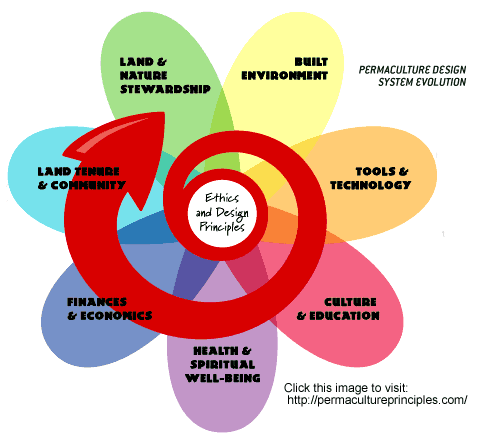
Permaculture Design System Evolution
A place to explore Transition, Re-skilling, Permaculture, and Slow Tech, while meeting the challenges of our Post-Carbon Future.
Wellbeing is defined as a “happy, healthy, or prosperous state.” Wellbeing Farm, therefore, will be a physical place where the principles of wellbeing in a post-carbon age are practiced, where Permaculture (an approach to designing human settlements and agricultural systems reflecting and conserving the natural world), and Transition (where those same principles, as well as other innovative approaches), are applied to solving the dual challenges of climate change and peak oil within the Hudson Valley Bioregion.
The necessity for establishing Wellbeing Farm first occurred to me and others in 2013 at the Mid-Atlantic Transition Hub Waterways Reskilling Gathering, when it became clear that those who attended and presented – Transition and Permaculture practitioners, farmers, millwrights, boat builders, post and beam barn and mill restorers, commercial fishermen, engineers, potters, weavers, and woodworkers — all needed a physical location and community center, a place to be, gather, hold workshops, teach classes, congregate, train apprentices, share stories, and create real world solutions to achieve an urgent Transition into the post-carbon Appropriate/Slow Tech era.. Slow Tech urges a thoughtful, empowering, nature-based process, utilizing a variety of scaled down tools with which to reshape human relationships, conserving time, energy, and our bioregional home.
Well Being Farm will address the entwined themes of education, food production and alternative energy production, health and wellness, and the equitable distribution of knowledge, along with the transfer of an abundance of innovative traditional processes and products to the local community.
Wellbeing Farm will be a physical place, located in the heart of the Hudson Valley Bioregion, where participants can move, by means of, hands-on experiences beyond abstract buzzwords – past “environmental,” or “sustainable, or “eco” this or that. Here, their work will focus on a Just Transition, giving everyone the tools needed to create the naturally viable means for living and being in community every day, on into a positive future — as we prosper economically, emotionally, and spiritually, beyond the realm of coal and oil.
WellbeingFarm won’t only teach pragmatics skills and livelihoods; it will be a living laboratory in which participants take part in designing Transition – where teachers and learners join in a collective adventure and commit to a common journey, originating pathways that lead beyond fossil fuels, helping people feel not like cogs in a faceless corporate gear, but like active, vital, creative individuals involved in the important work of revolutionary societal transformation.
Wellbeing Farm will be a center for Permaculture, the crafts of Transition, and for re-skilling to meet the challenges of a post-carbon world. The Farm will be a showplace, offering living demonstrations of the efficacy of local food and energy production, a place where practitioners will be given the time and space to develop and implement solutions intended to move the world away from an extraction and unlimited growth paradigm; toward a sustainable, steady-state economy that benefits the local community, its small businesses and residents.
Wellbeing Farm; the basics:
TheFarm will be centrally located in the Hudson River Bioregion.
Wellbeing Farm will house the headquarters of The Center for Post Carbon Logistics, the Hudson Valley Resilience Hub, and the Bioregional Traditional Knowledge Database and Library – offering these institutions one central place where colleagues can share expertise, experiences, stories, electronic and physical resources. Wellbeing Farm will serve as a “living library,” gathering and protecting historical knowledge, while exploring and promoting innovative sustainable solutions based in traditional crafts and skills.
The farm will regularly host the annual Hudson Valley Common Ground Country Fair, Chautauquas, and other bioregional celebrations.
Wellbeing Farm Mission
Wellbeing Farm will explore an array of innovative heritage and leading-edge technologies by which individuals, communities, and the Hudson Valley Bioregion can thrive in decades ahead – designing and realizing pragmatic, environmentally and economically sound tools for peacefully, equitably, and intelligently transitioning away from fossil fuels.
Wellbeing Farm will serve as an empowering example – demonstrating ethical livelihoods and teaching beneficial technologies that do minimal socio-environmental harm; methodologies that foster self-reliance and promote Slow Tech via hands-on practices, as professionals and students gather regularly from across our bioregion on a farmstead like no other in our region: a living laboratory cultivating not only resilient food production methods and energy and transportation solutions, but fresh, pathfinding ideas as well.
The Farm will take its essential lessons from nature, incorporating the values of earth stewardship, community cooperation, and individual initiative, while emphasizing the sharing of surplus, teaching that our actions have consequences, that we all have vital responsibilities, and ultimately fostering care and love for the environment, society and for each other.
The Power of Just Doing Stuff
Wellbeing Farm will teach traditional skills and re-skilling for a post-carbon world. It will house Permaculture demonstration projects; alternative energy and water conservation pilot projects; and a plethora of innovative educational activities offered up within beautiful, peaceful, productive, energy-efficient spaces where students, scholars and practitioners can meet, perhaps live, and learn from each other.
The farm will not stand alone, but will be integrated into the greater Hudson Valley community, with which it will engage collectively and creativity to unleash an extraordinary, historic Transition to a future beyond fossil fuels; a future that is vibrant, abundant, resilient, and ultimately preferable, more equitable, and more economically viable than the current model:
Wellbeing Farm will be a physical place, showcasing the efficacy of producing local food and power in our bioregion.
It will provide the space, time, structure, and opportunities needed in which practitioners can develop implementable ideas for achieving a locally focused, highly functioning, steady state economy.
The Farm’s workshops will preserve the skills and tools of the past, reworked and transformed into crafts that will serve us adroitly in a carbon constrained future. Among those skills: Wood fired ceramics; small scale iron forging and bronze casting; traditional rope making (using locally harvested natural fiber); woodworking; stone and thatch work; “passive – zero net energy” building design and construction; wind, water mill, and solar steam energy solutions; leather working to create tack for working horses; beer, cider, and spirit distilling utilized in food preservation and medicine making; “bio-digestors for methane and fertilizer; low carbon transportation (including “short sea” sailing freight vessels appropriate to the Hudson River, Hudson Estuary and coastal trade), plus a multitude of other post-carbon commerce and communication technologies.
Wellbeing Farm will provide educational opportunities for experimenting with, and realizing, real world solutions to the environmental, economic, and social crises we face today, and those we will face on into the future.
Wellbeing Farm will enable people working locally to transition our Hudson Valley communities and the bioregion from a consumptive industrial model to a restorative model — shifting to a truly sustainable economy dedicated to core values of human and environmental health, cultural and biological diversity, care for commonly held resources, and cooperative nonviolence.
Wellbeing Farm will, above all, focus on Transition: on the common journey we must all take together if civilization is to thrive, evolve and fulfill our dreams for a better world. This will not be a journey born of desperation or despair, but one that is joyful and empowering. To paraphrase the title of Rob Hopkins’ book: Wellbeing Farm will embody the Power of Just Doing Stuff!
Wellbeing Farm; Three Organizing Principles
Principle 1: Permaculture — Permaculture practitionersdesign ecologically-sound human habitats and food production systems. This discipline strives for the harmonious integration of human dwellings, farming techniques, and communities within the surrounding natural world, including the microclimate, annual and perennial plants, animals, soils, and water. The focus is not on these individual elements, but rather on the shifting relationships between them to create a prosperous balance between human and natural communities. This synergy is enhanced when human systems actively mimic patterns found in nature.
The core tenets of Permaculture are:
• Take Care of the Earth: Provide first for all life systems so they flourish and multiply.
• Take Care of the People: Offer everyone access to the resources needed to thrive.
• Share the Surplus: Healthy natural/human systems generate plentiful outputs for all.
Permaculture principles practiced at Wellbeing Farm will entail eco-friendly food production, and far more. Energy-efficient buildings, nature based wastewater treatment, recycling, and land stewardship are other key holistic components.
Permaculture on the Farm will include research into practical economic and social structures that support the evolution and realization of more sustainable communities, encompassing co-housing and eco-village models, for example. Participants at the Farm will look closely at ways in which we can all interact productively, while respecting and working closely with nature.
Principle 2: Transition — The Transition Movement represents one of the most promising models available to modern society today for engaging individuals and communities in the far-reaching actions required to mitigate the negative socio-economic-environmental impacts of peak oil, climate change, and the global financial crisis. A key component of Transition is a move away from a large-scale, global production/distribution model and toward re-localization – achieving fulfilling and equitable local livelihoods, lived in harmony with home bioregions.
Underpinning Transition is an understanding that peak oil, climate change and the global economic crisis require urgent local action now. Without that immediate action, an era of far-more-costly fossil fuels – marked by disastrous global supply chain interruptions and shortages – looms and is inevitable.
Industrial society has lost the resilience needed to cope with such system shocks. So immediate adaptation is essential. And we must act together, using all our skill, ingenuity and intelligence, our home-grown creativity and cooperation, to unleash the collective genius of local communities and our bioregion to achieve an abundant, connected, and healthier future for all.
Wellbeing Farm will not need to reinvent the wheel to meet these Transition challenges.
Transition US is an already existing, and vital resource for building resilient communities in the United States, while Kingston New York Transition is tuned into local issues and solutions. Both organizations are linked into the worldwide Transition movement in which hundreds of interconnected communities foster their own unique local initiatives, benefiting all.
In addition, The Good Work Institute envisions a Just Transition to environmentally sustainable and resilient systems in the Hudson River Bioregion by advancing ecological restoration; democratizing communities, wealth and the workplace; fostering racial justice and social equity; re-localizing production and consumption, and retaining and restoring cultures and traditions.
Principle 3: The Folk School –Wellbeing Farm will operate utilizing five well-established Folk School philosophies and values: 1). Re-skilling – offering training in a varied range of past and contemporary practical tools and skills; 2) Inclusivity – assuming everyone has something to add to the journey, and to creating a more sustainable and resilient Hudson Valley; 3) Honoring Elders – recognizing that the young can learn invaluable lessons from elders with unique skills and stories to share; 4) Awareness – Transition requires we give up old paradigms to create a viable, abundant future; 5) Networking – cooperation, not competition, is the key to all citizens benefiting from innovative new learning opportunities.
Yestermorrow School
Wellbeing Farm; Creating a Sense of Place
The physical location, acreage, scope of programs and services at Wellbeing Farm will be dependent on funding and upon the needs of practitioners in the Hudson Valley Bioregion. It may begin small, then grow to meet our post-carbon societal and educational needs.
As we envision it today, Wellbeing Farm will be centrally located on multiple acres in the Mid-Hudson Valley. It could be centered at a single location, or scattered at several, depending on availability of facilities, land, and community need. It should be located near public transportation, near or on a major body of water, and sited near other sustainable activity centers and established institutions such as the Farm Hub, Esopus Agriculture Center, Arrowhead Farm Agricultural Center, Garrison Institute, and the Omega Institute.
Element 1: The farm itself – No matter where situated, Wellbeing Farm must offer a welcoming, bucolic, stimulating, beautiful landscape in which to think, work, create and write – a place where practitioners can experience relationships between human beings and the natural world. Instructors and mentors will be drawn from a wide variety of disciplines and experiences; they will require physical amenities to achieve their teaching goals, for example:
Anagama Kiln
Builders will require sufficient land to construct full-sized buildings, for teaching post and beam, cob, cordwood, stone and thatch construction, and other green building methods.
Millwrights will need a place to build/repair water and wind projects
Farmers, foresters, and those working with horses will need sufficient land and facilities for crops and livestock, to practice veterinary skills, harness making and repair, and for modifying tractor-drawn machinery for horses.
Sail freighters will require a dry dock and waterway on which to build / rebuild small sail freight boats, learn rigging, and seamanship.
Wild foragers will require forest, meadow, and wetland habitat in which to teach forest gardening and gleaning techniques. Boyers (bow makers) and gunsmiths will likewise need a place where natural materials and tools are available.
Furniture makers must have a local source of wood, a sawmill, drying shed, and workshops.
Weavers will need a wool source, plus a place to clean, spin, and dye.
Potters will require clay, wheels, kilns and shelter.
All participants will need a place to socialize and learn skills from each other.
Ultimately, what may evolve is a centralized Wellbeing Farm facility, surrounded by nearby satellite locations providing all sorts of teaching opportunities for people of all ages.
Also, a portion of the farm must be left undisturbed and natural, serving as a place for nature observation and solitary contemplation.
LIbrary
Element 2: The Bioregional Traditional Knowledge Database – Wellbeing Farm will serve as a repository for vital traditional knowledge — encompassing arts, crafts, livelihoods, and connections to our natural heritage, all in danger of disappearance. This database will form an “extraordinary source of knowledge and cultural diversity from which the appropriate innovation solutions can be derived today and in the future.”
The Farm’s bioregional database will emulate and interface with the UNESCO International Traditional Knowledge Institute (ITKI) an ambitious project intended to preserve, restore, and promote the re-use of traditional skills and inventions from all over the world. ITKI includes among its important resources an online encyclopedia of low-tech know-how.
The physical and electronic database at Wellbeing Farm will include a collection of books, blueprints, photos, and drawings showing how things were made and how we fed ourselves in a pre-carbon world – including resources such as the Whole Earth Catalog, books published by Shelter Publications, the Foxfire books, mechanical engineering texts, trade encyclopedias, and downloaded and printed reproductions like Small Hydropower Systems, home built windpower, and books and resources for pre-petroleum technology.
Element 3: Common Ground Fair Hudson Valley – Working with the New York Organic Farming Association (NOFA-NY), Wellbeing Farm will provide space for an annual “Common Ground” Country Fair. This event will bring together a large gathering of farmers, change agents, artisans, musicians, Slow Money social entrepreneurs, Permaculture and Transition practitioners, Eco-Villagers, organic farmers, fishermen, seed companies, natural food stores, chefs, cooperatively owned small businesses and thousands of families from throughout the region interested in manifesting and welcoming a new approach to the future. This event, along with other celebratory activities will generate strong lasting bonds between the Farm and surrounding communities.
Element 4: Educational Opportunities for Children – Wellbeing Farm is, above all else, a place where people of all ages can learn. And while many participants will be adults honing new skills, it is vital that an honored seat at the table be maintained for children, and for their education.
Permaculture as a design system is rooted in an understanding of ecological principles – and it is best if that understanding is cultivated early, through sensory awareness of the natural world, natural cycles, energy flow and interconnectedness. For that reason, the farm will foster a close relationship with Hudson Valley Bioregion schools pre, primary and high schools, and existing programs such as Creek Iverson’s Seed Song Farm Summer Camp, and Wild Earth’s summer camp. Field trips will often arrive at the Farm, bringing young people to see how their world is being re-skilled; likewise, practitioners will travel to schools often to teach a range of new livelihoods.
In this way, the Farm will help ensure that our children have the best possible start to understanding the “why” behind the “how” of our Permaculture ways — learning skills that far transcend the deskbound limitations of old school education models. Children will be introduced to a vast range of hands-on crafts and folk art skills, ranging from toolmaking to basketry; clothing construction, fiber and fleece production; gardening and farming, gleaning and food preparation; learning to work with and respect working animals; while also cultivating a love for traditional, self-made music, storytelling, nature observation, and much more.
Wellbeing Farm; Why Now?
We live at a highly precarious – but also fascinating and hopeful – point in history. The convergence of massive challenges, particularly climate change, peak oil, and the global economic crisis, has brought us to an historical moment where we are profoundly prompted to act.
We the People are surrounded by “experts” telling us that we have gone too far, that civilization, and maybe humanity, are doomed; and worse that our end is inevitable – that the web of life as we know it will collapse catastrophically and soon.
The magnitude of the challenge ahead is huge, and the obstacles are plenty. But there is an emerging energy, positive spirit, and the will to succeed and thrive. There is a sense of exhilaration arising out of our talking and listening to each other, to not accepting the faltering status quo, but envisioning what we want and then rolling up our sleeves and starting to co-create it.
There is no denying the challenges we face, but there is also no denying the practical, instinctual, democratic response that is arising among We the People today. In towns and cities everywhere we are asking each other: “What can I do right now? How do we get started?”
In a world of rapidly diminishing resources and increasing stresses on natural and social systems, we must rapidly join to implement innovative equitable strategies to restore degraded landscapes, to feed all people well, to convert our energy-wasteful infrastructure into holistic natural/human systems that benefit everyone. Wellbeing Farm is part of that vision – a real place in the Hudson Valley Bioregion where we can create a bountiful future together.
“Life is a shipwreck, but we must not forget to sing in the lifeboats.” ― Voltaire
The sinking of the Titanic is horribly memorable for many reasons, but one stands out above all: that so many lives were needlessly lost due to “if only” or “what if.” The “unsinkable” vessel lacked sufficient lifeboats to easily hold all passengers and crew, and when launched, those boats were only partly filled.
Looking
deeper: many more Titanic passengers could have been saved if only the crew had
been better trained, if only the lifeboats had been deployed in a timely way, if
there had been a lifeboat drill, If third class “steerage” passengers had been assigned
emergency stations, and if only the ship’s captain had taken iceberg warnings
seriously instead of being in deadly denial. Today, no passenger vessel can
leave port without an adequate number of well provisioned lifeboats, proper
training and preparedness. So the impacts of disasters at sea, which do
inevitably occur, are minimized.
Leaping forward from an historic calamity to a looming catastrophe: the world is sailing toward a Titanic moment — a collision of unprecedented proportions between blasé “business as usual” planning and a rapidly escalating and increasingly violent climate crisis. New York’s Hudson Valley is the world in microcosm.
Looking forward rationally and unflinchingly at all major indicators, extreme
weather events far worse than Hurricanes Irene and Sandy could lie just over
the horizon, meaning that our communities could soon face cataclysmic food and
energy shortages, transportation disruptions, infrastructure failures,
inundation of vital facilities and valuable properties by sea level rise, a
massive financial meltdown and all manner of attendant debilitating social
disarray. But no one is seriously preparing.
Flooding
forest fire
We lack both the leadership and the necessary wherewithal at the state, regional, and community levels. But we know that intensifying climate shocks are no longer far off, low probability events. We’ve been warned not only by the climate models — maps of our potential future — but also by daily current events: unprecedented heatwaves storms and droughts are here now. For proof, we need look no further than the cataclysmic fires in Australia and the Amazon, or Paradise, California.
The stages of
climate grief:
With every passing day it grows more dangerous for us to depend on good
luck or forced optimism and false hope as our best protections. Sooner or later
the United States, the Northeast and the Hudson Valley will be slammed by
climate disaster. Will we be ready?
To help determine the healthy way ahead, let’s look at the stages of our
global trauma:
Denial – refusal to accept the facts/wishful thinking/blissful ignorance/fatalism
Last One Standing – everyone for themselves/anger/blame/battles over food, water and resources/despair/government collapse, failed state (Syria-ization) status.
Power Down – moving beyond blame to acceptance and toward adaptation
Obviously, we
need to move to the fourth stage as quickly as possible — without panic, acting
rationally as we prepare ourselves for unpredictable, but increasingly likely
climate shocks, the “what ifs” of our current historic moment.
Survivalists, preppers
and lifeboat builders:
Some may compare lifeboat builders with survivalists (1) and preppers (2) — those constructing fortified bunkers in remote areas to protect themselves from the “others” in event of “Apocalypse.”
But there is a significant difference: lifeboat builders aren’t only
thinking of themselves; they’re leading the way, constructing small, local, resilient
community systems where we will all be able to rely on each other for survival
and safety. This sort of local resilience allows us to live not separately, but
together in hope and possibility, rather than in fear — to thrive rather than merely
survive.
Like a ship captain and crew, however, today’s lifeboat builders must
prepare well in advance of chaos. They must anticipate disaster as it might
unfold, making sure they’ve provided enough boats, stocked them with adequate provisions
and trained crew who know how to respond in a crisis. As we sail into the uncertain
waters of climate chaos, we must ready our households, neighborhoods and
communities.
And just as we would never accuse a ship captain who conducts regular
lifeboat drills of “doom and gloom thinking,” we must face reality: the real
danger of impending climate chaos comes from us ignoring the signs and doing nothing.
Inaction puts us all at significant risk. Action offers us hope.
A New Narrative:
As a species, we are storytellers. And the stories we tell collectively,
whether they be found in Gilgamesh, the Bible, or traditional American History
all serve as action plans for the time. They tell us what worked well in the
past so we might move into a productive future. But sometimes those tales
become outdated and the signposts pointing to safety in the past instead lead
us down paths into danger.
The tale we’ve told ourselves over the last 300 years, since the Age of
Reason and on into the Modern Age of Expansion, is that we live in a time of limitless
progress, of ever-expanding opportunity and possibility, in which there is a
high technological fix for every problem.
In this story, we tell ourselves that unlimited growth and soaring GDP
is a real measure of economic health and community wellbeing; that a rising
stock market protects us, no matter how rundown our neighborhoods; that deregulation stimulates investment, even
as climate destabilizing emissions rise; and that national security need only
focus on existential threats beyond our borders, and not on quality of life and
preservation of civil liberties.
Today, climate change — along with the socio-environmental and economic upheaval it brings — is turning the idea of endless progress on its head
Unnatural disasters — pandemics, human-amplified heatwaves, intensified
storms and droughts, and rising sea levels falling like bombs randomly across
the landscape — are as destructive and demoralizing as war. Extreme weather
events now batter whole countries, states, cities, suburbs and rural areas;
disrupting commerce, undermining the bottom line, putting human lives at stake,
destroying homes and hopes.
That’s why it is long past time for us to tell a new story: one that
recognizes the turbulent sea of change we sail in; a story that recognizes the
dangers around us, but doesn’t demand a fear or grief response. This new story
inspires us to prepare together as communities with open eyes, minds and hearts
— ready to face the risks of impending calamity while embracing the promise of
resilience and hope of regeneration.
We need to change the narrative now, embrace a new story truer to
circumstance — a storyline in which we heroically face adversity together, creating
abundance out of crisis together, moving with agility through chaos toward new
community values that will sustain us in the unsettled years ahead.
The roots of that story are certain: we will thrive only by being earth
and community stewards, rather than exploiters; only by demanding that our leaders
address not only the economic balance sheet, but also our ecological and equity
balance sheets. Only then will we be able to go ahead with hope and find a safe
harbor in the climate crisis. Only then can we leave a better world for our children.
Planning
resilient, future-proof “too small to fail” Hudson Valley communities:
While it is true that there is little that small
communities can do to independently reverse climate change, there are many things
these same communities can do to mitigate the climate crisis in their area as
it unfolds, and to future-proof themselves against climate chaos.
Importantly, because communities are smaller than
states or nations, they have the capacity for rapid change and quick course
corrections. They are better able to bring citizenry together, to reach
consensus and to act decisively.
As such, individual Hudson River communities can
serve as laboratories, where citizens work together to build lifeboats, to
stock and staff them against the dangers ahead. Moreover, many local communities
acting in this way throughout the region could ultimately “float all boats” in
a climate emergency — increasing our chances of mutual survival across the
region.
Where to begin? Every community needs to start by objectively assessing threats. Then we need to unflinchingly evaluate the greatest points of weakness — whether these take the form of infrastructure; social, public health, economic and political structures. Finally, communities need to fortify those weaknesses against the storms to come — work that will enrich our towns and neighborhoods in the present, while reducing risk and enhancing resilience for the future.
food Security
A few practical lifeboat building ideas: community flood-proofing in preparation for climate chaos, implementation
of drought-resistant
landscaping,
institutionalization of green
building practices, zoning against development in climate disaster-prone
floodplains, the installation of redundant storm-proof energy systems, the establishment
of community-wide food security, and the creation of damage control centers
equipped to deal with sudden disasters — all of this and much more can protect our
communities now, while future-proofing them against the harms common on a much warmer,
more turbulent planet and in a post-carbon future.
Resilient communities are at the core of
a “Too Small to Fail” future. If we don’t plan for more robust proactive communities,
and implement solutions for looming problems, a catastrophic crash seems
inevitable. However, in our new storyline, crisis can equal opportunity — as
our nation learned during the Great Depression and World War II.
But if sensible democratically arrived at
plans to manage disaster aren’t formulated and pressed forward now, the
opportunity afforded by crisis could be hijacked by a better organized,
well-financed minority with an authoritarian agenda that benefits the few at
the cost of the many. One need look no further than autocratic governments in today’s
Brazil, Turkey, Venezuela, and China to see what is at risk.
Here is glimpse of what our Hudson Valley
Lifeboat Culture might look like:
Governance: We will prosper via an eclectic egalitarian innovative amalgam of businesses, public interest non-profits, county and municipal governments working together towards a common goal;
Energy production: We will promote rooftop and regional solar farms, wind farms, small hydro, tidal energy, community choice aggregation, and conservation to achieve energy independence from the global fossil fuel grid;
Food production and food security: We will encourage and protect rural and urban farmers (and the land), develop a new “Grange,” promote “victory” gardens and rooftop/backyard apiaries; convert city and suburban lots into linked “front yard” farms; provide opportunities for artisanal commercial fisheries, fish farmers, and fish mongers; grow our local farmers markets, and build and stock community/emergency food and water storage facilities.
Transportation: We will work toward a local water-based and human electric/transportation system to bring goods to market and continue to move people from place to place. That system will also be hardened and fortified against the impacts of rising sea levels and extreme weather events;
Emergency preparedness: In the event of an emergency citizens and organization have to be trained and in a position to augment the emergency services, or when those are overwhelmed take a leadership role in both preparing for disaster and implementing responses.
Environment: We will clean up our waterways to make them more productive; restore and create wetlands that guard against flooding and storm surges, while serving as nurseries for fish and wildlife; nurture wildlands and “forest gardens” where fruits, nuts, mushrooms and herbs can be sustainably harvested; manage sustainable forests that are logged selectively with an eye on future production; convert urban brownfields to greenfields that balance natural systems with commercial needs.
Economics: We will avoid sole reliance on a nationally volatile currency by creating a (or expanding the use of existing) local currency used to pay for local commodities; buying and hiring (and training) locally; creating public works projects for sustainable development, move away from an international and national economy toward a regional economy that fosters local businesses and micro-industries — ranging from brewers and butchers to cheese makers and toolmakers; from ship builders and seafarers, coopers, blacksmiths, and bicycle builders; local wind turbine, solar collector, and tidal generator manufacturers and installers; shoemakers, Repair Cafes, and fix it shops; composters and fryer fat oil recyclers. Land for farming and sustainable forestry will be protected through conservation easements and equitable urban development will be conserved through community land trusts.
Society and education: We will develop regional and seasonal “Common Ground” fairs and celebrations and Chautauqua’s with music, dancing, demonstrations and exhibits of local makers’ products, local food, beer, wine and spirits, and fellowship. Encourage an education system that doesn’t result in graduates leaving for other regions, but in their staying within their communities to pursue sustainable livelihoods. We will ensure affordable housing, improve work opportunities for disadvantaged groups, and allow seniors and children to play useful and valuable civic roles.
These goals can seem utopian, especially
if we look at them through the lens of the old story of “progress.” There are,
of course, also hard realities to contend with as we develop a Lifeboat Culture. The Hudson Valley and the New York City
Bioregion — is connected to the rest of the world by literally thousands of
lifelines, all of which are now at risk. These include an aging and
increasingly failure-prone power grid; an aging and leaky water system; and a
vast network of roads, rails, shipping and air routes that rely exclusively on
fossil fuels whose supply is prone to sudden cost spikes and shortages.
Like a patient on intravenous life
support, any major interruption in the flow of these resources to the region can hamstring or harm its economy and
people. With global oil, gas and coal production predicted to irreversibly
decline in the next 10 to 20 years, a related economic collapse becomes not a
question of if, but when — unless we act now to soften and deflect the blow,
creating redundant energy, food, product and transport systems that kick-in as
international resources become unreliable.
In the face of this reality, how do we transition
from the storyline of unlimited growth and intense capitalist competition to a
storyline that calls for community union, local shared economic prosperity, and
the building of a Lifeboat Culture? The journey begins as:
The region and its communities commit to being a leader in sustainability and resilience.
Local people hold their elected officials responsible for inaction and reward effective action.
We recognize that real economic pain is associated with the changes needed to mitigate and avoid the effects of sea level rise and climate change, and find ways to reduce that pain.
Any plan for a resilient bioregional
economy must insure that every citizen has fundamental needs met for nutritious
food, shelter, healthcare, education and ecosystem services. This must be a
non-negotiable condition if we are to meet the climate change challenges ahead
and satisfy the promise of our great egalitarian democracy.
As radical as the ideas presented in this
proposal may seem when seen from inside our current myopic progress-obsessed
worldview, many of these concepts are rooted in our common regional immigrant heritage:
my immigrant grandfather, for example, joined
with a friend who owned a pushcart to start a lumber company. They scavenged
construction sites daily for discarded lumber and wood scraps, selling the
material for what it was – a recycled product. They built their company into a
large wholesale/retail lumberyard, and eventually became a regional self-serve
hardware and lumber company.
What my grandfather and uncles, who
eventually took over the business, never forgot was that they had an obligation
to their employees — many of whom worked at the company for their entire
careers. The firm sold a good product, treated their customers with respect,
supported their community, and made a living for their families. But after my
uncles retired, their partner sold the company to a Fortune 500 company and
within a few years it no longer existed.
I tell this story for a reason: that
lumber company was a Main Street business — locally rooted and privately held.
It was innovative, successful, and sold materials to people who became repeat
customers because of the quality and service they received. As soon as the
company became the property of Wall Street, those values were lost; replaced
solely by a drive for limitless profit. Until that point, their business had
been “too small to fail.”
Evidence increasingly shows that every
dollar spent at a “too small to fail” locally owned business generates two to
four times more economic benefit – measured in income, wealth, jobs, and tax
revenue – than a dollar spent at a globally owned business. This is because
locally owned businesses spend much more of their money locally and thereby are
a regional economic multiplier.
Under our present economic system, large
transnational companies reap big profits. But no local businesses receive any
of our pension savings, investments in mutual funds, venture capital firms, or
hedge funds. The result is that many of us over-invest in Fortune 500 companies
we distrust, and under-invest in the local businesses we know are essential for
a strong local economy.
That’s why we need new mechanisms to
enable investment in local, place-based, “too small to fail” Main Street
businesses. At the heart of such mechanisms is our investment in a Lifeboat
Culture. By thinking small, not big; local, not global, we strengthen community
resilience against climate change.
Main Street investing is how the local
economy once functioned, and it was the basis of much 20th century
urban prosperity. It was then in the interest of well-off farmers, merchants,
and small town banks to loan money to, and invest in, businesses that hired
local people, in order to make something that held value and created real
wealth.
When we support “buy local / hire local” campaigns, promote “locavesting,” urge a resurgence of local currencies; and institute new public and community banks, community development financial institutions, credit unions and other local lending institutions, we reinvigorate our region’s Main Street economy. And by so doing, we strengthen our regional Lifeboat Culture — put simply, in such a world, the Hudson Valley thrives!
Revival of the Commons: Share
management of shared resources
A
key strategy of our Lifeboat Culture, if it is to succeed, will be for
communities to take back the commons — finding ways to
manage our waterways, fisheries, pastures, forests and other local landscapes in
a sustainable manner that can be productive for hundreds of years.
This means reinstituting many of the rules that
people created and used in generations past to protect shared resourced for
future generations so that they could be harvested and shared without degrading
ecosystems. While local supervision flies in the face of 21st
century trends of federal and state management, corporate exploitation, or
privatization — it helps to build community resilience.
Like a bank account, a farmer or fishermen never
removes more from a commons ecosystem than nature can replace in a reasonable
amount of time. And it is the community that ultimately benefits.
The co-operatives model:
Co-operatives in various forms (production, retail,
housing, and credit) are another organizational model in which ethics are
embodied and embedded, and which are vital to a functioning local Lifeboat
Culture.
Co-operative principles confer greater resilience –
which matches the priority for safety and security in difficult times. Although
there are no panaceas and co-ops can fail too, it is also true that co-ops have
a track record of longevity and survival that is superior in many cases to
private companies that is vital in times of economic contraction and environmental
turmoil.
Living fully in a
world of “what if”
At the start of this proposal we profiled the human tragedy resulting
from the wreck of the Titanic — an unnecessary loss of life that occurred not
only because of a natural disaster, but that resulted from human carelessness,
unpreparedness, elitist hubris and stupidity.
As the Hudson Valley sails into an uncertain, but surely dangerous,
climate crisis, we can learn from the horrors experienced by the Titanic on the
high seas. We can move steadily away from dependence on increasingly
undependable fossil fuels, giant transnational companies and international
finances. We can build energy, food and economic redundancies into local
communities to buffer them against international and national shortages and
systems collapses. We can invest in our neighborhoods and our neighbors,
working together to create “too small to fail” Main Street businesses, non-profits
and local governments that strive in union to serve their communities and the
people.
None of this will insure us totally against the dangers ahead, but preparedness as engendered in a Lifeboat Culture, will give our communities resilience and staying power. By acting now with foresight and hard work, we can care for each other, reinvesting in people and the land, creating a future for the Hudson Valley that emphasizes Earth Care, People Care and Fair Share.
We can create organizational and institutional structures that are sustainable, endowed with ethical values that serve all citizens not only a privileged elite. In our Hudson Valley Lifeboat Culture, the emphasis will not be on blind, reckless progress at all cost, but on the creation of an equitable society that avoids resource depletion while fostering slow growth, and most importantly, hope for everyone, including the most vulnerable people and species.
Ultimately, the journey begins simply, with the
joining of hands; the breaking of bread; and in taking a first step together,
in your community or in mine. I hope you’ll join me for the journey.
(1) a person who makes preparations to survive a widespread catastrophe, as an atomic war or anarchy, especially by storing food and weapons in a safe place.
(2) a person who believes a catastrophic disaster or emergency is likely to occur in the future and makes active preparations for it, typically by stockpiling food, ammunition, and other supplies. “there’s no agreement among preppers about what disaster is most imminent”
(3) a farmers’ association organized in 1867. The Grange sponsors social activities, community service,
Traditional
knowledge is in danger and its disappearance would not only cause
the loss of people’s capability to keep and pass on the artistic and
natural heritage, but also of an extraordinary source of knowledge and
cultural diversity from which the appropriate innovation solutions can be
derived today and in the future.
Lewis Mumford wrote in
1970, “The great feat of medieval technics was that it was able to promote
and absorb many important changes without losing the immense carryover of
inventions and skill from earlier cultures. In this lies one of it vital point
of superiority over the modern mode of monotechnics, which boast of
effacing, as fast and as far as possible, the technical achievements of
earlier periods.”
Slow Money, Slow Food, and Slow Tech
“ …..just as the last 10 years or so have brought people greater awareness about the provenance of their food, we believe this is the moment to move people towards a greater understanding of their technology.”
Slow Food
Slow Money is a movement to organize investors and donors to steer new sources of capital to small food enterprises, organic farms, and local food systems. The Slow Foodmovement aims to preserve cultural cuisine and in so doing to preserve the food plants and seeds, domestic animals and farming within an eco-region. It is also a social and political movement that resists the dehumanizing effects of fast food and corporate farming. Slow Tech is about the re-invigoration of heirloom technologies and traditional skills needed to thrive in a carbon-constrained future.
Transition and Permaculture
Transition is the movement by which people are re-skilled in heirloom technologies. Permaculture gave birth to the Transition movement and offers guidance on how to use those skills to design resilient lives. The ethics; earth care, people care, and fair share form the foundation for Permaculture and are also found in most traditional societies.
Transition fosters and supports the revitalization of Slow Tech skills and Permaculture asks us to consider relearning the proficiency needed to reanimate wind mills, watermills, and sailing vessel while putting hand tools, levers, and blocks and tackle back into service.
Permaculture incorporates knowledge from cultures that have existed in balance with their environment for much longer than our consumer centered fossil fueled society. We should not ignore the positive accomplishments of modern times, but in the transition to a sustainable future, we need to consider values and concepts different from what has become the social norm.
Slow Technology:
C.
Milton Dixon, interviewed in The (Chicago) Examiner, May 2011, said: “(high tech is) industrial technology
and refers to things that are out of your control, as opposed to low
technology, which is simple things done in a smart way. (S)Low technology is using
the intelligence of nature to accomplish tasks. High technology is buying
an apple from the store; low technology is getting an apple from a tree you
planted yourself. One of the big differences is in high technology you are
disconnected from cause and effect relationships. So if you pollute through
high technology, you may not feel the direct result. Low technology is
connection because you are involved in the process and you are directly
affected by the consequences.”
Small is Beautiful
The idea of Slow Technology has its roots in the ideological movement called “appropriate technology,” a term coined by E.F. Schumacher in his book “Small is Beautiful,” first published in 1973. Slow or appropriate technology centers on ideas of proper scale: technology should be “people-centered.” “Slow technology as an ideology that extends thoughtfulness about how devices shape our relationships to time, emotion and energy. Slow Technology is articulated in an article about the concept written about by two Swedish designers, Lars Hallnas and Johan Redstrom, who in 2001 described Slow Technology as “a design agenda for technology aimed at reflection and moments of mental rest rather than efficiency in performance.” The two also said, “The appropriate technology movement has at its philosophical heart the desire to capacitate people of all walks of life to create (1) Meaningful Employment, (2) Comprehension of Technology, (3) Self-Reliance, and (4) Reduced Environmental Impacts.”
It takes time to understand why it works the way it works,
It takes time to apply it
It takes time to see what it is
and it takes time to find out the consequences of using it
Slow Tech Practice:
Hand Woodworking Tools
No woodworker’s first project is a chair, a house, or a boat. My first lesson in woodworking was to take a piece of rough lumber, and using hand tools, shape it into a three dimensional absolutely square finished piece of wood. It took me a full day and I used every tool on my bench.
Chairs
Once my practice was established I developed a method that worked for
me. First I sat with a piece of tracing paper and did a rough sketch of
the final product. Then I drew it full scale in three views. From
that drawing I could determine what amount of wood was needed, where each joint
would go, and how the pieces would transition from one to another to create an
aesthetically pleasing whole. Then the sawing, planing, joinery, shaping,
and finishing would take place. Each of those steps were learned by
doing, learning from others, by using traditional references, and knowing that
the dimensions and materials were appropriate for the final use.
I was lucky both to have mentors and to have the time to hone my skills first as a student of Alan Lazarus at Virginia Commonwealth University and then as a resident woodworker at Peters Valley Craft Center in New Jersey. Peters Valley gave me the opportunity, and the time, to learn the business, practice my craft, and teach. It also was a community of like-minded professional potters, weavers, metal workers, and woodworkers that supported one another.
If we are to learn the skills necessary to survive and thrive in a post carbon world, more places like Peters Valley will be necessary, more experienced craft workers will have to open their shops to apprentices, and more people are going to have to be willing to take the time, resources, and effort to learn.
In future posts I will talk about preserving other skills and tools to
serve a post carbon future such as building and restoring water and wind mills,
wooden boat building, repair and restoration, artisanal fishing, farming, and “future
proof” communities.
There are
schools and apprentice shops for learning large-scale woodworking and metal
working skills that are and will be needed for Slow Tech water-driven mills,
and wind-driven vessels that will be part of the continuum that supersedes the
“blip” of petroleum powered short term thinking and consumption.
The following are some links to the resources, books, skills, and techniques that are needed to adapt to carbon constrained future that is resilient, abundant, and equitable.
Water Mill
Let the following lists of links and books be a starting point – an opportunity to contribute your own favorite sites, books, drawings, and especially experiences with humans with these skills. Perhaps this list can be the beginning of a Traditional Knowledge Database that will gather and protect historical knowledge and promote innovative practices based on traditional skills.
The Nature and Art of Workmanship, David Pye, Herbert Press
How to Keep Your Volkswagen Alive, A Manual of the Step by Step Procedures for the Compleat Idiot, John Muir and Tosh Gregg, Avalon Travel/Perseus Books.
The Power of Just Doing Stuff, Rob Hopkins, Transition Books
A Museum of Early American Tools, Eric Sloane, Wilfred Funk
Why We Make Things and Why it Matters, Peter Korn, David R. Godine
The Craftsman, Richard Sennett, Yale University Press
Zen and the Art of Motorcycle Maintenance, Robert M. Pirsig, Harper Torch
Shop Class as Soulcraft, Matthew B. Crawford, Penguin Press
Despite its present dominance, our
current logistics system engaged in moving people and goods from place to place
is fragile. It is reliant upon carbon-based fuels driving internal combustion
engines. It is interwoven into long-distance, globalized world trade. It is
designed for Just-In-Time delivery. And it depends upon its present ability to
avoid paying for negative externalities such as carbon emissions and environmental
pollution, and to avoid being governed by meaningful labor, environmental,
health, and other laws. The World Economic Forum determined in 2018 that if
shipping were a country, it would be the world’s sixth-biggest greenhouse gas
emitter.
There are serious doubts as to the capacity of the current system to
adapt to structural changes in the status quo. The political context is
changing and, in some regions, unstable. Carbon pricing regimes are likely to
arrive in the coming years, which will raise prices for carbon-based fuels and
for producing goods.
Warming is undermining agriculture and fishing in many regions, and
other economic sectors may be affected. Climate-triggered conflict is already
causing mass migration, which is in turn improving the political fortunes of
nativist political groups, which is already straining the current world trade
model. These trends and unpredictable new shocks are certain to strain the
system in the coming years and decades. As an increasing number of sectors act
on the need to reduce carbon emissions and an increasing number of policies and
strains make carbon prices higher and more volatile, the question is whether
local, national, and global economies are prepared.
Better than asking whether we will be
prepared is knowing that changes both predicted and unpredicted are happening
and more are on the way—and then asking how we should prepare.
How can a new approach to transportation logistics be developed that is
resilient to the climate emergency and the resulting changes in the economic
landscape, one that stands some chance of preserving some of our current
standard of living for future generations, one that is also equitable,
inclusive, and just in delivering the benefits of the new system and whatever
version of shipping and trade is to come for future decades and generations?
To answer these questions, we have created the Center for Post Carbon Logistics (CPCL), Our approach is to identify new—and old—technologies, skills, economic models, and regulatory and logistics practices that will serve the future.
Our approach will be both global and local. Globally, CPCL will search for examples of effective techniques, both current and historic, that have moved goods and people from place to place. We will consider examples ranging from Renault and Neoline’s partnership to build a wind-powered ro-ro vessel and cutting edge solar and wind-assist sailing technologies, to existing and in-development trade routes promoted by the International Windship Association and others, to traditional small-scale sail, low-or zero-carbon shipping like Fair Transport, and first and last-mile logistics that have been used for generations and will once again be viable. Hudson Valley contemporary examples are the sail freight vessel Apollonia, and the Hudson River Maritime Museum’s solar electric Coast Guard inspected passenger vessel Solaris.
Locally, CPCL will model, implement, and evaluate the development of these global practices. One aspect of this will be to build partnerships with local governments, businesses, economic and community development organizations, and nonprofits to develop new, resilient “working waterfronts” that will facilitate regional waterborne shipping, connecting goods to low-carbon first and last-mile delivery modes and creating economic opportunity and jobs. CPCL’s local pilot projects in the Hudson Valley will bring direct local benefits while providing insights to be disseminated widely for locally-tailored replication elsewhere.
CPCL will also build a central library and database collecting low- and
zero-carbon techniques, skills, and tools for shipbuilding, rigging, ship
loading, port operations, warehousing, trading houses, and first and last-mile
logistics.
Rigger
Researchers will collect these practices. Existing skills and tools that
are at risk of being lost will be preserved. To build a community of practice,
CPCL will provide training and apprenticeship programs with participating
partners, developing the necessary local workforce and catalyzing job creation.
CPCL will also disseminate the knowledge that it creates and preserves, exhibit
at and host regional, national, and international conferences on post carbon
logistics and sail freight. It will partner with Hudson Valley institutions to
host exhibits for the public.
The climate crisis is already here, and even though the exact timing is
not yet obvious, it is clear that the contemporary logistics system will have
to adapt. In the Hudson Valley, local farmers and food processors, distillers,
brewers, and cider makers, are already looking for low carbon ways to move their
goods beyond the local market; there are practitioners who are ready and
willing to pass on their knowledge; local governments are desperate to find new
economic development strategies; and consumers are hungry for lower
carbon-footprint goods. These are the challenges and opportunities in which the
Center for Post Carbon Logistics will engage.
Melding 19th and 21st Century
Technologies for Waterborne Freight and Passenger Transport
Our world is now convulsed by three great converging crises: climate change, global economic instability, and peak everything. Add to these principal threats the risks of wars over natural resources, climate migration, the total failure of aging and over stressed infrastructure, and the erosion of traditional community values. Each of these crises presents particularly thorny problems for the New York City Metropolitan area and the Hudson Valley Bio-region.
Our region is at a crossroads. Looking
forward rationally at all the indicators, the “business as usual” choice takes
us down a road to cataclysmic energy shortages and infrastructure failure, to
inundation from sea level rise, to financial meltdown and its attendant social
disarray.
There are four possible response strategies:
Denial – waiting and hoping that some unforeseen miracle will solve the problem
Last One Standing – global competition and warfare to control all remaining resources;
Power Down down – global cooperation to reduce energy use, conserve and manage resources, while reducing population; and
Today the far-flung international trade network that once pumped vibrant economic life into the region threatens to collapse as imported natural resources, pollution from shipping, and the fossil fuels needed to transport goods will soon become increasingly scarce and expensive. Higher petroleum costs, and turmoil in countries in which much of our imported goods are made could snap that lifeline. The present system is unsustainable.
The rivers, bays, canals, and coasts of the Hudson Valley, NY Harbor,
and Mid-Atlantic continue to be a marine highway, but one that is limited to
deeply dredged channels leading to container ports and fossil fuel and chemical
tank farms. Traffic consists of the movement of consumer goods,
automobiles, and spirits from around the world on large ocean going fossil
fueled container ships to ports where the containers are loaded onto trucks for
delivery to warehouses for distribution in a “just in time” logistics
system.
Moving goods and people from place to place in a carbon constrained future will be dependent on sailing vessels, hybrid/fossil free electric ships, and people, bicycle, and animal powered transport for first and last mile logistics. These methods of transport will meld 19th and 21st Century Technology. Ships will be (re)built locally from locally sourced or recycled materials and will be crewed by locally trained seafarers. The ships will provide a carbon neutral trading link, will be a laboratory for innovation and competitiveness, will be commercially competitive with conventional fossil fuel transport in certain markets, will operate on reliable schedules (dependent on tide, wind, and weather), and offer competitive freight rates on appropriate routes.
This executive summary of a monologue in support of the Center for Post Carbon Logistics (The Center) includes a plan for Hudson Valley/Mid-Atlantic river bay, coastal, and ocean shipping of fair trade cargo. The time is right and an opportunity exists now to reinvent and profit from low carbon cargo delivery. Post carbon ships have many advantages over larger oil powered cargo ships. Sailing and alternative fuel freighters can locally promote:
job creation in farming,
logistics, ship building and maintenance among others
Revitalization of
waterfront communities by preserving the working waterfront and commercial
enterprises, while providing more public access, and recreation.
Food production and distribution, and connecting
producers to buyers
The mission of the Center for Post Carbon Logistics is to provide the pragmatic means to survive the decades ahead and to provide the tools to transition to a more resilient, equitable, and sustainable world. The Center will do so by providing individuals and communities with no-nonsense methods of transitioning away from the use of fossil fuels for transporting goods and passengers. The Center will research and assist in the implementation of appropriate or Slow Technology[1] needed to respond to the inevitable equity, economic, ecological, and energy crises of the 21st century.
The idea of Slow Technology or “Slow Tech” has its roots in the ideological movement called “appropriate technology,” a term coined by E.F. Schumacher in his book Small is Beautiful, first published in 1973. Slow Tech should be thoughtful about how devices shape our relationships to time, emotion, energy, and bioregional environment.
The Center will house a widely
accessible traditional knowledge data base, library, and a pre/post carbon
tool, technology, and machinery collection.
The Center will promote Slow
Technology
The Center will be an advocate for
existing and emerging low carbon shipping and post carbon transportation
businesses..
The Center will provide educational
opportunities and creative, implementable, real world solutions to the
environmental, economic, and social crises we are likely to face in the near
and mid-term future.
The Center will enable people to work
locally to transition our communities and bioregion away from a fossil
fuel-based economy to a “restorative economy,” one that is human-scaled,
embraces alternative locally based energy, and that is less extractive.
The Center will host regional,
national, and international conferences on post carbon logistics and sail
freight and will be an advocate for working waterfronts throughout the Canals,
the Hudson Valley, NY Harbor, and the Atlantic Coast.
The Center will partner with other
enterprises and organizations to provide a physical place where professional
practitioners and apprentices can participate in theory and practice workshops
for preserving the skills of the past to serve the future.
The Center will advocate for a
Transition that people will embrace it as a collective adventure, as a common
journey, as something positive, and how communities can feel alive, positive
and included in this process of societal transformation. Paraphrasing the title
of Transition Town Rob Hopkins’ book, The Center for Post Carbon Logistics will
be the embodiment of the “Power of Just Doing Stuff.”
Kingston, NY as well as, every community along the Canals, the Hudson
River, NY Harbor and the North East US Coast will have to engage its collective
creativity to unleash an extraordinary and historic transition to a
future beyond fossil fuels; a future that is more vibrant, abundant and resilient; one that is
ultimately preferable to the present.