Pallet-based intermodal container
The Center for Post Carbon Logistics Pallet Container Project is the next “tool in the box” in decarbonizing and rescaling the regional supply chain. Designed to increase the efficiency and safety of near-zero emission short sea shipping and cargo bike urban supply chains. The Pallet Container has the potential to make sailing cargo vessels and bike deliveries economically superior to trucking while slashing congestion and pollution.
The Center for Post Carbon Logistics (CPCL) has announced a collaboration with the University of Vermont’s Senior Experience in Engineering and Design (SEED) program to develop the next generation of cargo containers for regional trade. This system will be compatible with existing pallet-based logistics chains, while working specifically with the intermodal constraints of cargo bikes and small sailing vessels. With a payload of 180 kgs (400 lbs.), and a max gross weight of 200 kgs (445 lbs.), these containers will be lift-on/lift-off capable, simple to swap between zero-emission ships, electric cargo bikes, and light electric vehicles.
The Center for Post Carbon Logistics educates, engineers, and advocates for small vessels and small ports to revive sustainable short sea shipping in the United States. This project fulfills one of the CPCL’s main engineering priorities: To design the tools for efficient and safe cargo handling, alongside modern sailing cargo vessels and modular floating port infrastructure.

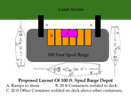
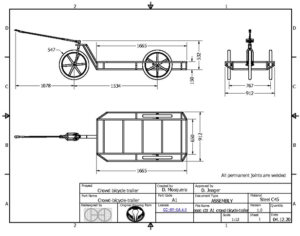
Sailing cargo vessel, floating spud barge port, and bicycle trailer for pallet-based intermodal container
A team of four mechanical engineering students, Silvia Murdoch-Meyer, Giorgia Mari, Lucas Daly, and Oren Beckwith, have been diligently working on the project since the start of the fall 2025 semester, and are expected to complete the work by late April 2026. Their design, complete with working prototype, will be on display at the annual Design Night from 5-7pm on April 24 at the Davis Center, UVM. Their design work has created a container which is durable, lightweight, made of sustainable materials, and scaled for the needs of sustainable cargo transportation in the 21st century.
CPCL will release the container design as an open-source hardware standard after its completion. This will allow anyone to manufacture, modify, or otherwise adapt the container to their uses worldwide without licensing fees. The standard will be released under a Creative Commons “Share-Alike” license, meaning that any such derivative designs must also be freely shared for others to use. Future derivative designs planned by the CPCL include refrigerated, insulated, and liquid tanker units.
“These containers solve a number of challenges for sustainable short sea shipping,” said Steven Woods, the CPCL Director of Research and Development. “They make cargo handling safer and more efficient, while encouraging the use of zero-emission last-mile deliveries. They can be stowed with minimal wasted space in small vessels and lifted in and out of hatches more easily than a conventional pallet. You can also make this box into a chilled unit, maintaining the cold chain for fresh produce without the need for a fully refrigerated hold on a small vessel where space and tonnage are at a premium.”
While there are some similarly designed containers currently in use, none are designed for intermodal use with cargo bikes, leaving critical gaps in capability for short sea shipping use. Most are also protected by patents, making them more expensive to purchase and produce. Additionally, most are also made of difficult-to-recycle plastics and require specialized equipment for manufacture. This design will not be subject to these constraints and add critical capabilities for shipboard use.
To support the work of the Center for Post Carbon Logistics, and to move the pallet container project from prototype to open source production model please click here.
For more information contact: Steven Woods, Director of Research and Development, 603.276.9103, Andrew Willner, Executive Director, 732.768.4848


Leave a Reply