This post originally appeared on the Hudson River Maritime Museum’s Riverwise website on June 25, 2020
The Hudson, the River that flows both ways has been a transportation corridor for hundreds of years before Europeans first saw it. The Hudson rises in the mountains at Lake Tear of the Clouds in Essex County, NY and empties into Upper New York Bay. The Hudson is a drowned river as its bottom is below sea level almost all the way to Albany. The Hudson is also considered a fjord one of very few in North America. The River has been a commerce highway for as long as humans have inhabited the North American continent. Henry Hudson and other early European explorers were convinced that the River was part of the Northwest Passage.
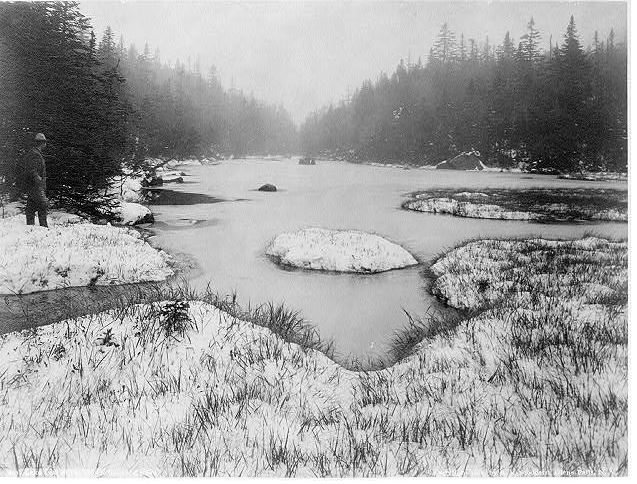
Lake Tear of the Clouds, headwaters of the Hudson River, c. 1888. Photograph by Seneca Ray Stoddard. Library of Congress
The Hudson River once formed a bustling highway linking even the smallest communities to a web of regularly scheduled commercial routes. Schooners, sloops, barges, and steamboats provided a unique way of life for early river town inhabitants. Farmers, merchants, and oystermen relied on this vibrant and diverse fleet of vessels to bring in supplies and deliver their goods to market. This arm-of-the-sea was an integral part of the lives of those who worked New York’s inland waters.
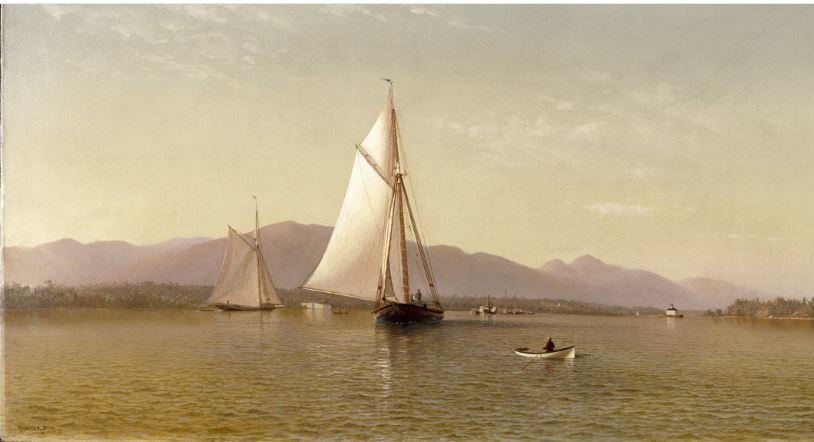
“The Hudson at Tappan Zee,” Francis Silva, 1876, Brooklyn Museum of Art. This painting is actually not at Tappan Zee, but more likely near the Esopus Meadows and depicts the 1830s Esopus Meadows Lighthouse in the background.
The Hudson is connected through New York Harbor to the Coast and the rest of the world. With one of the world’s greatest ice-free harbors on earth, New York City was built on a shipping industry that has over time become a dangerously tenuous lifeline to the outside world for the region. Today the far-flung international trade network that once pumped vibrant economic life into the region threatens to collapse as imported natural resources and the fossil fuels needed to transport them become increasingly scarce and expensive. Higher petroleum costs, and higher wages in countries in which much of our imported goods are made could snap that lifeline.
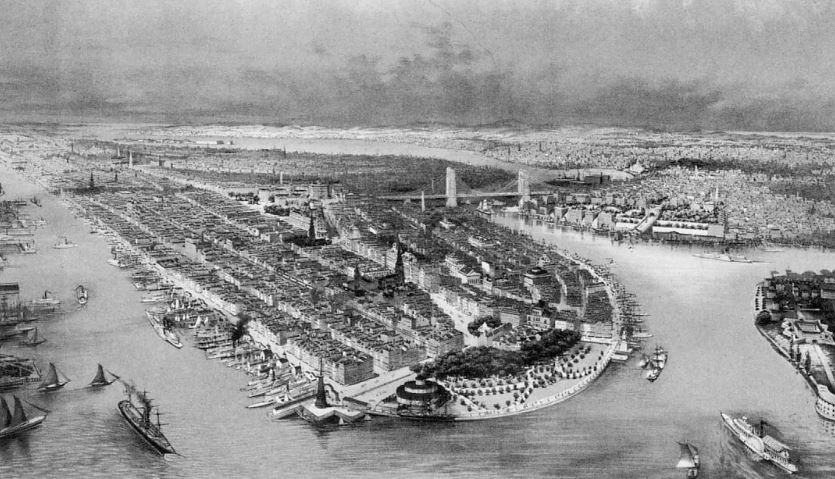
Aerial view illustration of the tip of Manhattan in New York City, featuring Castle Garden in Battery Park and docks on the rivers. Brooklyn Bridge under construction is shown in exaggerated scale, circa 1880. Library of Congress.
New York State’s working waterfronts have long been a key contributor to the region’s financial well-being and our nation’s economy. But, in a carbon constrained future, how will goods and people be moved from place to place, and what role will the Hudson River play in this vision?
How should we meet the looming challenges of climate change, rising sea level, aging infrastructure, changes to global shipping patterns, threats to food security, and the risks these changes bring to New York’s Hudson Valley.
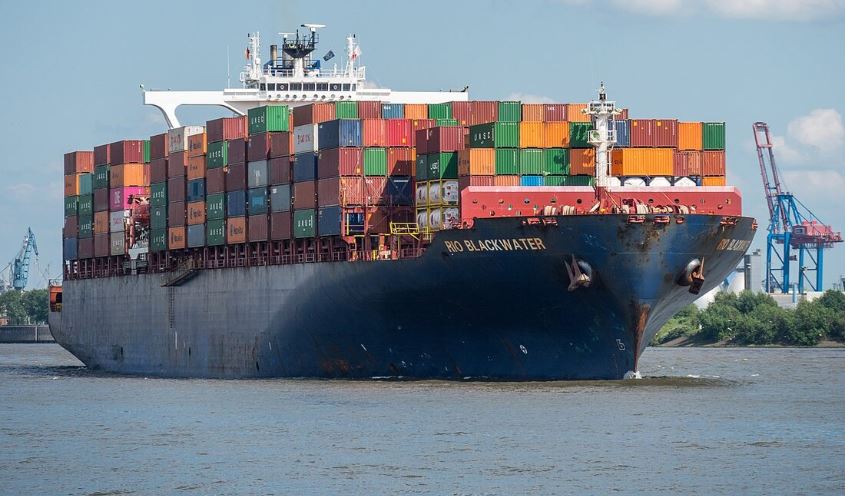
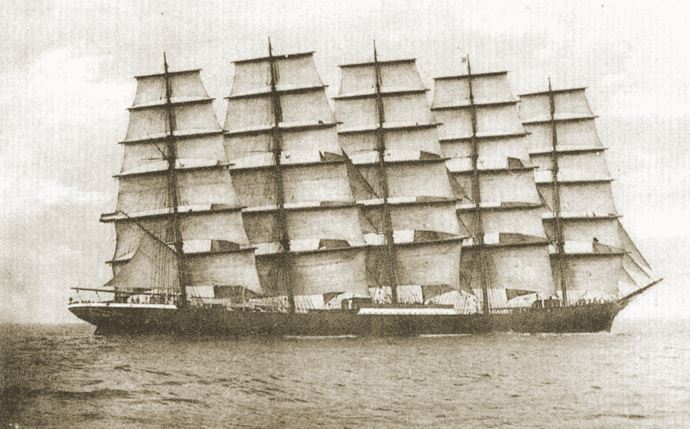
Photo by Joachim Kohler Bremen.
The biggest question of all: How do we address this daunting multitude of challenges and turn them into opportunities for transforming waterfronts and ports to effectively and efficiently serve our regional economy far into the future?
The solution in this time of rapid change may be a return to the “Slow Technology” of our recent past — sail powered freight ships – and to the present, solar powered ferries and barges. Tomorrow, New York City’s port and the ports of the Hudson Valley will likely continue to be a commercial hubs due to their strategic location, but those harbors will likely resemble their 18th and 19th century selves rather than the ports we know today.
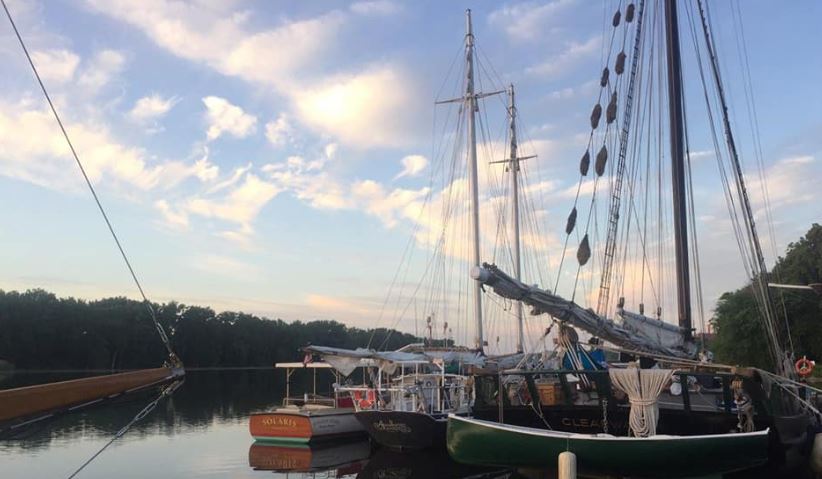
Solaris, Apollonia, and Clearwater rafted together at Albany, NY.
We hope the “RiverWise: North Hudson Voyage” has served to engage the public and commercial interests along the Hudson in how these two important examples of 19th and 21st Century technology will create opportunities for communities to re-examine how their waterfronts will be used for recreation, conservation, and commerce. This voyage of discovery is the first of many with more and more ships joining this flotilla of hope and inspiration. The next step will be even more critical, to commit to honestly confronting challenges, while also boldly embracing opportunities and possibilities. We must move forward quickly and vigorously, and we need to do more. We must inspire individuals, communities, local leaders, city and state governments to commit to creating a thriving, post carbon transportation and logistics system. We must also commit to the creation of a network of sustainable blue waterways in a region that advocates for a post carbon transition that people will embrace as a collective adventure, as a common journey, as something positive, and above all, as a future full of Hope.
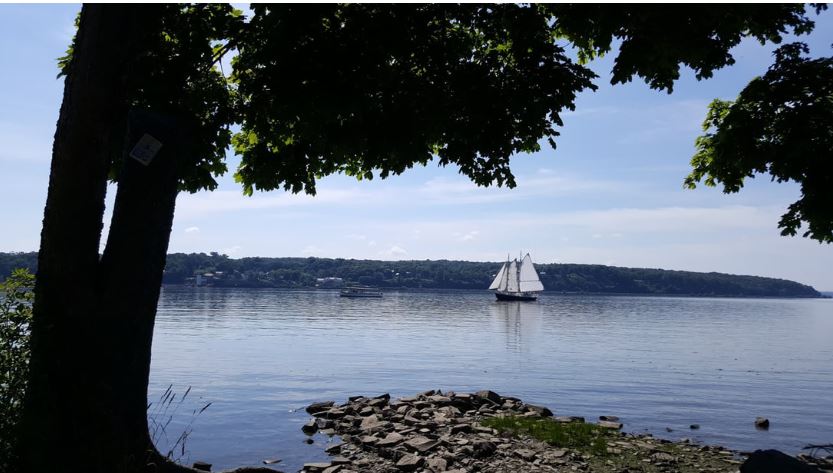
Solaris and Apollonia passing Kingston Point. Photo by Carla Lesh.
“Life is a shipwreck, but we must not forget to sing in the lifeboats.” ― Voltaire
The sinking of the Titanic is horribly memorable for many reasons, but one stands out above all: that so many lives were needlessly lost due to “if only” or “what if.” The “unsinkable” vessel lacked sufficient lifeboats to easily hold all passengers and crew, and when launched, those boats were only partly filled.
Looking
deeper: many more Titanic passengers could have been saved if only the crew had
been better trained, if only the lifeboats had been deployed in a timely way, if
there had been a lifeboat drill, If third class “steerage” passengers had been assigned
emergency stations, and if only the ship’s captain had taken iceberg warnings
seriously instead of being in deadly denial. Today, no passenger vessel can
leave port without an adequate number of well provisioned lifeboats, proper
training and preparedness. So the impacts of disasters at sea, which do
inevitably occur, are minimized.
Leaping forward from an historic calamity to a looming catastrophe: the world is sailing toward a Titanic moment — a collision of unprecedented proportions between blasé “business as usual” planning and a rapidly escalating and increasingly violent climate crisis. New York’s Hudson Valley is the world in microcosm.
Looking forward rationally and unflinchingly at all major indicators, extreme
weather events far worse than Hurricanes Irene and Sandy could lie just over
the horizon, meaning that our communities could soon face cataclysmic food and
energy shortages, transportation disruptions, infrastructure failures,
inundation of vital facilities and valuable properties by sea level rise, a
massive financial meltdown and all manner of attendant debilitating social
disarray. But no one is seriously preparing.
Flooding
forest fire
We lack both the leadership and the necessary wherewithal at the state, regional, and community levels. But we know that intensifying climate shocks are no longer far off, low probability events. We’ve been warned not only by the climate models — maps of our potential future — but also by daily current events: unprecedented heatwaves storms and droughts are here now. For proof, we need look no further than the cataclysmic fires in Australia and the Amazon, or Paradise, California.
The stages of
climate grief:
With every passing day it grows more dangerous for us to depend on good
luck or forced optimism and false hope as our best protections. Sooner or later
the United States, the Northeast and the Hudson Valley will be slammed by
climate disaster. Will we be ready?
To help determine the healthy way ahead, let’s look at the stages of our
global trauma:
Denial – refusal to accept the facts/wishful thinking/blissful ignorance/fatalism
Last One Standing – everyone for themselves/anger/blame/battles over food, water and resources/despair/government collapse, failed state (Syria-ization) status.
Power Down – moving beyond blame to acceptance and toward adaptation
Obviously, we
need to move to the fourth stage as quickly as possible — without panic, acting
rationally as we prepare ourselves for unpredictable, but increasingly likely
climate shocks, the “what ifs” of our current historic moment.
Survivalists, preppers
and lifeboat builders:
Some may compare lifeboat builders with survivalists (1) and preppers (2) — those constructing fortified bunkers in remote areas to protect themselves from the “others” in event of “Apocalypse.”
But there is a significant difference: lifeboat builders aren’t only
thinking of themselves; they’re leading the way, constructing small, local, resilient
community systems where we will all be able to rely on each other for survival
and safety. This sort of local resilience allows us to live not separately, but
together in hope and possibility, rather than in fear — to thrive rather than merely
survive.
Like a ship captain and crew, however, today’s lifeboat builders must
prepare well in advance of chaos. They must anticipate disaster as it might
unfold, making sure they’ve provided enough boats, stocked them with adequate provisions
and trained crew who know how to respond in a crisis. As we sail into the uncertain
waters of climate chaos, we must ready our households, neighborhoods and
communities.
And just as we would never accuse a ship captain who conducts regular
lifeboat drills of “doom and gloom thinking,” we must face reality: the real
danger of impending climate chaos comes from us ignoring the signs and doing nothing.
Inaction puts us all at significant risk. Action offers us hope.
A New Narrative:
As a species, we are storytellers. And the stories we tell collectively,
whether they be found in Gilgamesh, the Bible, or traditional American History
all serve as action plans for the time. They tell us what worked well in the
past so we might move into a productive future. But sometimes those tales
become outdated and the signposts pointing to safety in the past instead lead
us down paths into danger.
The tale we’ve told ourselves over the last 300 years, since the Age of
Reason and on into the Modern Age of Expansion, is that we live in a time of limitless
progress, of ever-expanding opportunity and possibility, in which there is a
high technological fix for every problem.
In this story, we tell ourselves that unlimited growth and soaring GDP
is a real measure of economic health and community wellbeing; that a rising
stock market protects us, no matter how rundown our neighborhoods; that deregulation stimulates investment, even
as climate destabilizing emissions rise; and that national security need only
focus on existential threats beyond our borders, and not on quality of life and
preservation of civil liberties.
Today, climate change — along with the socio-environmental and economic upheaval it brings — is turning the idea of endless progress on its head
Unnatural disasters — pandemics, human-amplified heatwaves, intensified
storms and droughts, and rising sea levels falling like bombs randomly across
the landscape — are as destructive and demoralizing as war. Extreme weather
events now batter whole countries, states, cities, suburbs and rural areas;
disrupting commerce, undermining the bottom line, putting human lives at stake,
destroying homes and hopes.
That’s why it is long past time for us to tell a new story: one that
recognizes the turbulent sea of change we sail in; a story that recognizes the
dangers around us, but doesn’t demand a fear or grief response. This new story
inspires us to prepare together as communities with open eyes, minds and hearts
— ready to face the risks of impending calamity while embracing the promise of
resilience and hope of regeneration.
We need to change the narrative now, embrace a new story truer to
circumstance — a storyline in which we heroically face adversity together, creating
abundance out of crisis together, moving with agility through chaos toward new
community values that will sustain us in the unsettled years ahead.
The roots of that story are certain: we will thrive only by being earth
and community stewards, rather than exploiters; only by demanding that our leaders
address not only the economic balance sheet, but also our ecological and equity
balance sheets. Only then will we be able to go ahead with hope and find a safe
harbor in the climate crisis. Only then can we leave a better world for our children.
Planning
resilient, future-proof “too small to fail” Hudson Valley communities:
While it is true that there is little that small
communities can do to independently reverse climate change, there are many things
these same communities can do to mitigate the climate crisis in their area as
it unfolds, and to future-proof themselves against climate chaos.
Importantly, because communities are smaller than
states or nations, they have the capacity for rapid change and quick course
corrections. They are better able to bring citizenry together, to reach
consensus and to act decisively.
As such, individual Hudson River communities can
serve as laboratories, where citizens work together to build lifeboats, to
stock and staff them against the dangers ahead. Moreover, many local communities
acting in this way throughout the region could ultimately “float all boats” in
a climate emergency — increasing our chances of mutual survival across the
region.
Where to begin? Every community needs to start by objectively assessing threats. Then we need to unflinchingly evaluate the greatest points of weakness — whether these take the form of infrastructure; social, public health, economic and political structures. Finally, communities need to fortify those weaknesses against the storms to come — work that will enrich our towns and neighborhoods in the present, while reducing risk and enhancing resilience for the future.
food Security
A few practical lifeboat building ideas: community flood-proofing in preparation for climate chaos, implementation
of drought-resistant
landscaping,
institutionalization of green
building practices, zoning against development in climate disaster-prone
floodplains, the installation of redundant storm-proof energy systems, the establishment
of community-wide food security, and the creation of damage control centers
equipped to deal with sudden disasters — all of this and much more can protect our
communities now, while future-proofing them against the harms common on a much warmer,
more turbulent planet and in a post-carbon future.
Resilient communities are at the core of
a “Too Small to Fail” future. If we don’t plan for more robust proactive communities,
and implement solutions for looming problems, a catastrophic crash seems
inevitable. However, in our new storyline, crisis can equal opportunity — as
our nation learned during the Great Depression and World War II.
But if sensible democratically arrived at
plans to manage disaster aren’t formulated and pressed forward now, the
opportunity afforded by crisis could be hijacked by a better organized,
well-financed minority with an authoritarian agenda that benefits the few at
the cost of the many. One need look no further than autocratic governments in today’s
Brazil, Turkey, Venezuela, and China to see what is at risk.
Here is glimpse of what our Hudson Valley
Lifeboat Culture might look like:
Governance: We will prosper via an eclectic egalitarian innovative amalgam of businesses, public interest non-profits, county and municipal governments working together towards a common goal;
Energy production: We will promote rooftop and regional solar farms, wind farms, small hydro, tidal energy, community choice aggregation, and conservation to achieve energy independence from the global fossil fuel grid;
Food production and food security: We will encourage and protect rural and urban farmers (and the land), develop a new “Grange,” promote “victory” gardens and rooftop/backyard apiaries; convert city and suburban lots into linked “front yard” farms; provide opportunities for artisanal commercial fisheries, fish farmers, and fish mongers; grow our local farmers markets, and build and stock community/emergency food and water storage facilities.
Transportation: We will work toward a local water-based and human electric/transportation system to bring goods to market and continue to move people from place to place. That system will also be hardened and fortified against the impacts of rising sea levels and extreme weather events;
Emergency preparedness: In the event of an emergency citizens and organization have to be trained and in a position to augment the emergency services, or when those are overwhelmed take a leadership role in both preparing for disaster and implementing responses.
Environment: We will clean up our waterways to make them more productive; restore and create wetlands that guard against flooding and storm surges, while serving as nurseries for fish and wildlife; nurture wildlands and “forest gardens” where fruits, nuts, mushrooms and herbs can be sustainably harvested; manage sustainable forests that are logged selectively with an eye on future production; convert urban brownfields to greenfields that balance natural systems with commercial needs.
Economics: We will avoid sole reliance on a nationally volatile currency by creating a (or expanding the use of existing) local currency used to pay for local commodities; buying and hiring (and training) locally; creating public works projects for sustainable development, move away from an international and national economy toward a regional economy that fosters local businesses and micro-industries — ranging from brewers and butchers to cheese makers and toolmakers; from ship builders and seafarers, coopers, blacksmiths, and bicycle builders; local wind turbine, solar collector, and tidal generator manufacturers and installers; shoemakers, Repair Cafes, and fix it shops; composters and fryer fat oil recyclers. Land for farming and sustainable forestry will be protected through conservation easements and equitable urban development will be conserved through community land trusts.
Society and education: We will develop regional and seasonal “Common Ground” fairs and celebrations and Chautauqua’s with music, dancing, demonstrations and exhibits of local makers’ products, local food, beer, wine and spirits, and fellowship. Encourage an education system that doesn’t result in graduates leaving for other regions, but in their staying within their communities to pursue sustainable livelihoods. We will ensure affordable housing, improve work opportunities for disadvantaged groups, and allow seniors and children to play useful and valuable civic roles.
These goals can seem utopian, especially
if we look at them through the lens of the old story of “progress.” There are,
of course, also hard realities to contend with as we develop a Lifeboat Culture. The Hudson Valley and the New York City
Bioregion — is connected to the rest of the world by literally thousands of
lifelines, all of which are now at risk. These include an aging and
increasingly failure-prone power grid; an aging and leaky water system; and a
vast network of roads, rails, shipping and air routes that rely exclusively on
fossil fuels whose supply is prone to sudden cost spikes and shortages.
Like a patient on intravenous life
support, any major interruption in the flow of these resources to the region can hamstring or harm its economy and
people. With global oil, gas and coal production predicted to irreversibly
decline in the next 10 to 20 years, a related economic collapse becomes not a
question of if, but when — unless we act now to soften and deflect the blow,
creating redundant energy, food, product and transport systems that kick-in as
international resources become unreliable.
In the face of this reality, how do we transition
from the storyline of unlimited growth and intense capitalist competition to a
storyline that calls for community union, local shared economic prosperity, and
the building of a Lifeboat Culture? The journey begins as:
The region and its communities commit to being a leader in sustainability and resilience.
Local people hold their elected officials responsible for inaction and reward effective action.
We recognize that real economic pain is associated with the changes needed to mitigate and avoid the effects of sea level rise and climate change, and find ways to reduce that pain.
Any plan for a resilient bioregional
economy must insure that every citizen has fundamental needs met for nutritious
food, shelter, healthcare, education and ecosystem services. This must be a
non-negotiable condition if we are to meet the climate change challenges ahead
and satisfy the promise of our great egalitarian democracy.
As radical as the ideas presented in this
proposal may seem when seen from inside our current myopic progress-obsessed
worldview, many of these concepts are rooted in our common regional immigrant heritage:
my immigrant grandfather, for example, joined
with a friend who owned a pushcart to start a lumber company. They scavenged
construction sites daily for discarded lumber and wood scraps, selling the
material for what it was – a recycled product. They built their company into a
large wholesale/retail lumberyard, and eventually became a regional self-serve
hardware and lumber company.
What my grandfather and uncles, who
eventually took over the business, never forgot was that they had an obligation
to their employees — many of whom worked at the company for their entire
careers. The firm sold a good product, treated their customers with respect,
supported their community, and made a living for their families. But after my
uncles retired, their partner sold the company to a Fortune 500 company and
within a few years it no longer existed.
I tell this story for a reason: that
lumber company was a Main Street business — locally rooted and privately held.
It was innovative, successful, and sold materials to people who became repeat
customers because of the quality and service they received. As soon as the
company became the property of Wall Street, those values were lost; replaced
solely by a drive for limitless profit. Until that point, their business had
been “too small to fail.”
Evidence increasingly shows that every
dollar spent at a “too small to fail” locally owned business generates two to
four times more economic benefit – measured in income, wealth, jobs, and tax
revenue – than a dollar spent at a globally owned business. This is because
locally owned businesses spend much more of their money locally and thereby are
a regional economic multiplier.
Under our present economic system, large
transnational companies reap big profits. But no local businesses receive any
of our pension savings, investments in mutual funds, venture capital firms, or
hedge funds. The result is that many of us over-invest in Fortune 500 companies
we distrust, and under-invest in the local businesses we know are essential for
a strong local economy.
That’s why we need new mechanisms to
enable investment in local, place-based, “too small to fail” Main Street
businesses. At the heart of such mechanisms is our investment in a Lifeboat
Culture. By thinking small, not big; local, not global, we strengthen community
resilience against climate change.
Main Street investing is how the local
economy once functioned, and it was the basis of much 20th century
urban prosperity. It was then in the interest of well-off farmers, merchants,
and small town banks to loan money to, and invest in, businesses that hired
local people, in order to make something that held value and created real
wealth.
When we support “buy local / hire local” campaigns, promote “locavesting,” urge a resurgence of local currencies; and institute new public and community banks, community development financial institutions, credit unions and other local lending institutions, we reinvigorate our region’s Main Street economy. And by so doing, we strengthen our regional Lifeboat Culture — put simply, in such a world, the Hudson Valley thrives!
Revival of the Commons: Share
management of shared resources
A
key strategy of our Lifeboat Culture, if it is to succeed, will be for
communities to take back the commons — finding ways to
manage our waterways, fisheries, pastures, forests and other local landscapes in
a sustainable manner that can be productive for hundreds of years.
This means reinstituting many of the rules that
people created and used in generations past to protect shared resourced for
future generations so that they could be harvested and shared without degrading
ecosystems. While local supervision flies in the face of 21st
century trends of federal and state management, corporate exploitation, or
privatization — it helps to build community resilience.
Like a bank account, a farmer or fishermen never
removes more from a commons ecosystem than nature can replace in a reasonable
amount of time. And it is the community that ultimately benefits.
The co-operatives model:
Co-operatives in various forms (production, retail,
housing, and credit) are another organizational model in which ethics are
embodied and embedded, and which are vital to a functioning local Lifeboat
Culture.
Co-operative principles confer greater resilience –
which matches the priority for safety and security in difficult times. Although
there are no panaceas and co-ops can fail too, it is also true that co-ops have
a track record of longevity and survival that is superior in many cases to
private companies that is vital in times of economic contraction and environmental
turmoil.
Living fully in a
world of “what if”
At the start of this proposal we profiled the human tragedy resulting
from the wreck of the Titanic — an unnecessary loss of life that occurred not
only because of a natural disaster, but that resulted from human carelessness,
unpreparedness, elitist hubris and stupidity.
As the Hudson Valley sails into an uncertain, but surely dangerous,
climate crisis, we can learn from the horrors experienced by the Titanic on the
high seas. We can move steadily away from dependence on increasingly
undependable fossil fuels, giant transnational companies and international
finances. We can build energy, food and economic redundancies into local
communities to buffer them against international and national shortages and
systems collapses. We can invest in our neighborhoods and our neighbors,
working together to create “too small to fail” Main Street businesses, non-profits
and local governments that strive in union to serve their communities and the
people.
None of this will insure us totally against the dangers ahead, but preparedness as engendered in a Lifeboat Culture, will give our communities resilience and staying power. By acting now with foresight and hard work, we can care for each other, reinvesting in people and the land, creating a future for the Hudson Valley that emphasizes Earth Care, People Care and Fair Share.
We can create organizational and institutional structures that are sustainable, endowed with ethical values that serve all citizens not only a privileged elite. In our Hudson Valley Lifeboat Culture, the emphasis will not be on blind, reckless progress at all cost, but on the creation of an equitable society that avoids resource depletion while fostering slow growth, and most importantly, hope for everyone, including the most vulnerable people and species.
Ultimately, the journey begins simply, with the
joining of hands; the breaking of bread; and in taking a first step together,
in your community or in mine. I hope you’ll join me for the journey.
(1) a person who makes preparations to survive a widespread catastrophe, as an atomic war or anarchy, especially by storing food and weapons in a safe place.
(2) a person who believes a catastrophic disaster or emergency is likely to occur in the future and makes active preparations for it, typically by stockpiling food, ammunition, and other supplies. “there’s no agreement among preppers about what disaster is most imminent”
(3) a farmers’ association organized in 1867. The Grange sponsors social activities, community service,
“Moving goods and people from place to place in a carbon constrained future will be dependent on sailing vessels, hybrid/fossil free electric ships, and people/electric, powered transport for first and last mile logistics. “
New York’s Working Waterfront has long been a key contributor to the region’s
financial wellbeing and our nation’s economy. But, in a carbon constrained
future, how will goods and people be moved from place to place, and what role
will The City’s Waterfront play in this vision? How should we meet the looming
challenges of climate change, rising sea level, aging infrastructure, changes
to global shipping patterns, threats to food security, and the risks these
changes bring to New York’s financial sector?
The biggest question of all: How do we address this daunting multitude
of challenges and turn them into opportunities for transforming the waterfront
and Port in order to effectively and efficiently serve our regional and
national economy far into the future?
“Life at the water’s edge is rapidly changing. The impacts of new technology, patterns of urban development, and globalization are redefining global logistics, and while some waterfront cities will thrive as ports and grow under these new conditions, others will need to evolve in order to survive and succeed…. How will New York re-invent its waterfront?”
If present trends continue, New York Harbor will need to be transformed into a hub of the spokes for “short sea shipping” (any movement of freight by water that doesn’t cross oceans such as freight ferries, short-haul barges and various other marine vessels). rather than serving as an unsustainable container cargo port. The good news: the New York metro region has an extensive network of waterways, and so is very well suited for the short sea shipping mode of freight transport. Moreover, public agencies and private companies are investigating the potential economic and environmental benefits of transferring more cargo from road to sea.
As New York moves forward to the working waterfront of tomorrow, the constraints, and in some cases the advantages, of smaller and (s)lower tech modes of transport must be considered; allowing for the integration of slowtech transport into harbor infrastructure to support these imminent changes.
If the New York
port is to thrive, 19th, 20th, and 21st Century
technology must meld seamlessly into new, mid-century methods of transport, also
with an emphasis on what might seem like bygone, but productive, methodologies
in order to become more self-sufficient and sustainable.
To offer just one example, ships of all sorts will need to be built (and rebuilt) locally, from locally sourced or recycled materials, and be crewed by locally trained seafarers, in order to adjust to declines in these resources globally, declines brought on by the climate crisis and social upheaval abroad. These new vessels will likely be very different than the ones built today
As fossil fuels become more expensive and are restricted by climate change policy, port infrastructure will need to be part of a carbon neutral trading network that links us to the region and the world. The good news: our port is well positioned to become a laboratory for maritime innovation, offering competitive freight rates on 18th and 19th Century shipping routes enhanced by 21st Century technology.
A Port Facing
the Greatest Challenges in Its History
Our world is now convulsed by converging crises of a magnitude never seen by humanity: climate change and sea level rise, global economic instability, and peak everything. Add to these threats the risk of wars over natural resources, climate migration, failure of aging and over stressed infrastructure, unstable economies, and the erosion of community values. Each of these crises presents particularly thorny problems for New York City, its Port, and the region. Challenges which also offer opportunities.
New York City owes its very existence to its location on one of the greatest ice-free harbors on earth; in turn, that great urban powerhouse was built on its Harbor and shipping industry. But as new threats loom, our aging Port has devolved into a dangerously tenuous lifeline to the world overseas.
Mid-west drought
Today, the
far-flung international trade network that once pumped vibrant economic life
into New York City and our region is threatened with collapse as imported
natural resources grow more expensive, carbon pollution from shipping grows
much worse, and the fossil fuels needed to transport goods become increasingly
scarce and costly. Spiralling petroleum costs, and turmoil in nations upon which
we rely for imported goods could snap our international lifeline at any time.
The present system
is unsustainable, so we must prepare to transform it, and we must move quickly
It’s important to understand that all of the many crises we face are
intimately linked to each other, and magnify each other, impacting our port’s
future. Just a few troubling examples:
A severe long-term drought in the American Midwest, could cut off our region’s supply of wheat, corn and soy, causing food shortages and a financial calamity.
Peak oil requires that we drill for fossil fuels in increasingly extreme landscapes, like the deep-water Gulf of Mexico, prone to more and more powerful hurricanes, or by using hydraulic fracturing that will likely contaminate groundwater in the heart of our regional foodshed, and the grain belt. Sudden price surges would impact shipping and our Port.
Our sprawling global oil pipeline stretches around the globe, making us vulnerable and dependent on volatile states prone to war, revolution, and migratory upheaval. Again, such conflicts could seriously impact global commerce and our Port.
An economic crash or a financially-sapping resource war abroad, could wreck our balance of trade and shatter our tax base, then making it fiscally impossible to adapt our infrastructure to accommodate climate change impacts, which would lead to more unpreparedness and economic hardship.
Meanwhile, poor harbor planning, and inappropriate non-water-dependent development along New York City’s flood prone waterfront could seriously hamper adaptation to these many crises.
The accumulation and interaction of such shocks could be catastrophic if
we do not prepare
Despite its present dominance, the New York Port and its current maritime logistics system remains fragile. It is reliant upon carbon-based fuels, driving internal combustion engines. This local fossil fuel-dependent system is interwoven into long-distance, globalized trade and is designed for Just-In-Time delivery. Importantly, it also depends upon a financial accounting system that avoids paying for negative environmental and social externalities such as global warming, environmental pollution, and sea level rise. But the bill for these negative externalities is coming due now and will be paid by our Port, our city, and our regional economy for decades to come if we don’t prepare to prevent that from happening.
Here is a stark reality that we must deal with if
we are to thrive as a 21st Century Port: The
World Economic Forum determined in 2018 that if shipping were a country, it
would be the world’s sixth-biggest greenhouse gas emitter. Those maritime
emissions must be slashed, and soon. That being true, there are grave doubts
that our current shipping system can easily adapt to the policy and
technological shifts needed to successfully curb climate change. But failure to
adapt will be catastrophic for our Port: sea level rise alone could make sure
of that. So we have no choice: we must adapt.
The NY/NJ Port, New
York City’s working waterfront, and the greater region are at a crossroads, a
turning point. Looking forward rationally at all the indicators, our “business
as usual” carbon model, dependent on globe-trotting fossil fuel powered
container ships is putting us on course for systemic failure, marked by
cataclysmic energy shortages and infrastructure collapse, inundation from sea
level rise, financial meltdown and its attendant social disarray.
For those who think otherwise, our climate change future and its inevitable impacts were foreshadowed when Hurricane Sandy made landfall in New York City in October 2010, bringing with it a destructive wall of water that flooded subway tunnels and neighborhoods, cut off power to lower Manhattan, washed away century-old structures, cost the city millions, and left it forever changed. Sandy “was a turning point, that’s true not just for anticipating future Sandy-like storms, but also for predicting overall sea-level rise and such climate-change impacts as more frequent heat waves, which the New York City Panel on Climate Change projects will triple by the 2050s.”
Despite widespread agreement upon these future climate change-driven inevitabilities, the Port Authority — because it has invested so heavily in large container port infrastructure — continues to write “resiliency” reports, even as large container ships becomes increasingly obsolete — outdated dinosaurs at the end of a fossil fuel era.
It is also expected that Port Authority will continue to pour
millions of dollars into incremental “port improvements,” while failing to
address the inexorable rise of the sea and the eventual destruction of most of its
expensive industrial port infrastructure. Likewise, the Corps of Engineers,
despite some attempts at “greenwashing” remains in denial, as are the City of
New York, and the States of New York and New Jersey. Bold initiatives proposed
after Hurricane Sandy collect dust on agency bookshelves. Attempts at “pilot” projects related to climate
change protection and adaptation have so far been way too feeble, too small and
too late.
Meeting
Challenges of a 21st Century Port
If the Port (and the City and Region it serves) survives into the
second half of this century it will be
significantly smaller, more sustainable, and resilient with an emphasis on
adaptation, and realistic outcomes for the continuation of the transport of
goods and people.
The contemporary Port of NY/NJ is the largest
port on the East Coast and the third largest in the US. For the freight
offloaded at its facilities, our Port is just one stop in an extensive
intermodal distribution chain.
But here’s another important fact: we drastically underutilize an invaluable regional transportation resource: our local waterways. In New York City’s metro region, 80% of freight transport today is carried by truck, a practice that congests our highways, increases air pollution, and is entirely dependent on fossil fuels. In the context of a working waterfront of the second third of the 21st century, (electric) trucks and rail may continue to have relevance in city-to-city transport, but all large trucks will likely have necessarily disappeared from the urban core. Congestion, pollution, and quality of life issues make this inevitable. And Just in Time delivery will be replaced by Warehouse in Transit Logistics (WIT or Warehouse –in- transit” is the successor to JIT or just-in-time which is now selectively outdated. Many cargoes that speed along highways to spend days in a warehouse could as easily and more economically / beneficially move by water).
In the 18th, and 19th and
early 20th centuries, the Hudson River, the New York Harbor, and the NY/NJ Harbor
Estuary and its river tributaries served as a bustling network of marine highways
linking even the smallest communities to a web of regularly scheduled
commercial routes. Boats of all sizes met local cargo and passenger needs: schooners,
sloops, barges, and steamboats connected river town inhabitants. Farmers,
merchants, and oystermen relied on this vibrant and diverse fleet of vessels to
bring in supplies and deliver goods to market. The NY/NJ Harbor Estuary and its
tributaries — and the ships and boats sailing them — were vital and integral to
those who worked and lived along our inland waters.
Historically, thousands of vessels plied these marine highways,
sailing to and from The City’s Harbor to the farming communities of New
Jersey and the Hudson Valley, delivering fresh local farm produce, fish,
shellfish, and passengers to ports along the way.
Today, those marine highways
still exist, but thanks to the boom in highway construction in the mid-20th
Century, have fallen into deep neglect. They now need to be
reinvigorated. Injecting new life into these regional maritime trade
routes is far more than just a celebration of tradition. In a carbon
constrained future, sustainable water transport will be a necessity. As the climate crisis deepens, water-based low-or-no
carbon transportation routes could link communities throughout the region.
The rivers, bays, canals, and coasts of the Hudson Valley, NY
Harbor, and Mid-Atlantic region continue to be a marine highway today, but one
that is limited to deeply dredged channels leading to container ports and
fossil fuel and chemical tank farms.
In a carbon constrained future, we will need to return to our
region’s nautical roots and advocate for the maritime,
and for the “first and last mile technology” necessary for moving goods and
people from place to place minimizing carbon pollution, opting for existing and
emerging low carbon shipping and post carbon transportation businesses and
organizations.
Question: How can we rapidly develop a new approach to waterway transportation
logistics that is attentive to, and resilient to the climate emergency? And
under fast-evolving environmental and social conditions, how can we alter our
Port to sustain a vibrant economy and standard of living for ourselves and future
generations — one that is also equitable and inclusive?
Vision for a Working Waterfront
and NY Port in the Second Third of the 21st Century
Oddly enough, a vision for an efficient,
economically vibrant, post carbon working waterfront in the 2030s, ‘40s and ‘50s
will likely resemble the New York Harbor of the late 19th century,
rather than what we see today. The Harbor of the near future will need to link
not only to roadways and railways, but to our region’s marine highways, which
will carry massive amounts of cargo and people.
Shoreline infrastructure will have to scale down and increase in capacity, and be nimble in its response to rising sea levels and more violent storms. It will have to be accessible to smaller, more numerous vessels on a preserved and restored Working Waterfront that is socially and culturally integral to the communities and our ‘sense of place” and include:
Charging stations for electric and electric hybrid vessels, flood-proof storage and production facilities for biofuels like methane (from sewage treatment plants), biodiesel (from used fryer fat), and hydrogen (created from seawater while sailing vessels are underway).
Waterfront and flood proofed warehouses and trading houses, business that specializes in facilitating transactions between a home country and foreign countries. (A trading house is an exporter, importer and also a trader that purchases and sells products for other businesses. Trading houses provide a service for businesses that want international trade experts to receive or deliver goods or services).
Local ship and boat building and repair facilities to support a local fleet,
More accessible customs clearance areas,
More traditional break bulk cranes for bulk, palletized, and bagged cargo,
Cross-docking facilities for transfer of goods from larger ocean-going ships to smaller short sea shipping vessels, and for transfer to first and last mile providers, i.e. small sailing, rowing, hybrid vessels as well as people/electric powered small commercial trikes and wagons.
Access for docking of “historic” ships to enable the “new” traders and seafarer models for “preserving the tools and skills of the past to serve the future.”
To bring these infrastructure changes about, we
will need to immediately establish:
A new agreement with transport unions to allow ships to load and unload with their own equipment. Working with the Unions to hire and train more people for post carbon longshore work.
A partnership with the region’s Maritime Academies and the Harbor School to retrain mariners and for logistics careers for the new post carbon working waterfront; creating a maritime education center where professional practitioners and apprentices can participate in practical workshops to relearn maritime and Port skills of the past to serve the future.
An endowment for a new “sailor’s snug harbor for the “aged, decrepit and worn-out sailors”
An endowment for the preservation and utilization of traditional maritime skills and tools, and a traditional knowledge database, library, and pre/post carbon tool, technology, and machinery collection. This activity serves to preserve, restore and promote the re-use of traditional skills.
Establish a Sustainable Working Waterfront Toolkit—enumerating the historical and current uses and economics of New York’s waterfront. The toolkit must include legal, policy, and financing tools which river ports, blue highways and estuarine communities can use to preserve and enhance local and regional port facilities.
Create maritime mixed-use zones where public parks, walkways and bikeways are built in flood zones and are adjacent to and part of a working waterfront.
Advocate for a reduced, less intrusive regulatory role for the US Army Corps of Engineers. Instead, encourage funding to the Corps for partnerships with other agencies, non-profit organizations, and an engaged public for developing, and redeveloping, a sustainable NY Port in a carbon constrained future, including but not limited to working with NY/NJ Baykeeper, the billion oyster project, and the Hudson River Foundation to build oyster reefs for habitat improvement and shoreline protection.
The New Working Waterfront will also:
Create jobs in seafaring, logistics, ship building, harbor maintenance
and more.
Revitalize waterfront communities by preserving the working waterfront and
commercial enterprises, while providing more public access and recreation.
Improve regional food production and distribution, linking producers to
buyers.
Imagining our Working Waterfront, circa 2050
Put simply, the shift from road, rail, and
fossil fuel dependence, to dependence on our region’s extensive network of marine
highways in a low-or-no carbon era, is a “breeze.”
Water-based transportation is just about the
only form of transportation other than the bicycle that requires little or no
roadway maintenance. There are no surfaces to grade or pave, no tracks, no
bridges or trestles to care for. Of course, canals need to be restored and
preserved; navigation channels need to be marked with buoys; locks and
lighthouses need to be manned and maintained. But unlike motorway or railroad
maintenance, these activities don’t require a large industrial base, and are
far less energy-intensive than alternatives.
The 363-mile-long Erie Canal system, linking
the Atlantic Ocean with the Great Lakes, for example, has been continuously operational
and profitable since 1825. The cost of keeping it running is tiny compared to
the cost of equivalent highway mileage and with winters expected to be more
mild the canal may be open year round.
The Hudson, Long Island Sound, the Bays of New
York Harbor, and a significant number of natural and artificial waterways in
the US and Canada comprise the greatest set of transportation assets in the world.
Those marine highways will only see their status grow in a post carbon world —
and the NY/NJ Harbor area is especially blessed with such waterways.
Let’s imagine: It is a hot, humid, late autumn day in 2050. From a high floor in one of lower Manhattan’s surviving skyscrapers, a trading house ship spotter, sees the topmasts of a tall ship entering the Lower Bay. The watcher signals the pilot schooner on post off of what was once Sandy Hook, and waiting Tug Augustin Mouchot a solar powered tug are dispatched to tow the engineless sea-going square rigger to a berth in the new port in the recently completed Gowanus Bay and Erie Basin Harbor with its oyster encrusted seawall created by repurposing concrete and stone from waterfront buildings and piers inundated by rising seas over the last 30 years.
Clipper Ship
The ship, the Jorne Langelaan, named after the builder of the first of the post carbon Eco-Clippers, has its crew aloft putting a harbor furl on the hemp cloth sails. She carries a mixed cargo of Caribbean fair trade coffee and cocoa beans bound for the region’s roasters and chocolatiers as well as preserved tropical fruits and rum. The Langelaan is looking a little “worse for wear” having skirted the 5th named Atlantic storm of the season. But her New York trained crew of young men and women is in good spirits, looking forward to spending time ashore, and to a few drinks of brew, cider, and spirits locally made and delivered by sloop and schooner from around the region, and to a good meal at a cafe serving up dishes harvested from the Harbor’s new artisan fishery and from oyster beds in shallows created by submerged piers and streets.
A long shore crew,
warehouse workers, drovers and their electric assist people-powered tricycles and
wagons converge at the waterfront’s new storm-proofed floating dock — which
rises and falls with surging tides. Cargo surveyors assist with the loading of schooners.
Crews on solar electric canal barges and sloops make ready to transfer cargo
from the Langelaan to their holds,
and to carry that cargo to ports up and down the Hudson River, to the newly
opened Delaware and Raritan, and Delaware and Hudson Canals, coastal New
Jersey, Long Island, and New England.
The Pilot Schooner comes
alongside the Langelaan and the pilot
goes up the ladder to the helm to direct the square rigger to its destination. Customs
agents sail from Staten Island to clear the cargo.
A huge tarred manila hemp hawser
is passed to the ship from the tug and the last few miles to port pass under
the clipper’s hull. The docking pilot skillfully moves the ship to the dock
while the Clipper’s crew readies the ship’s gear, opening hatches, and starting
up a steam winch that will do most of the lifting. There are also floating
cargo cranes that can be used for cargo heavier or bulkier than can be handled
by the ship’s gear.
This (s)low tech port makes
the best use of tried and true 19th century technology, supported
with 21st century solar and battery electric gear and vehicles. More
people are at work on the waterfront than any time since the 1920s; there are
more warehouses and trading houses, ship building, repair facilities, and docking
facilities than at any time in New York’s nautical history.
Just behind the waterfront
are sail and rope makers utilizing New York hemp; forges and foundries using
concentrated solar heat to form steel and bronze fittings. Riggers are hard at
work in rope walks making running rigging and dock lines for the numerous
sailing ships. Dry docks and shipyards look out on bikeways and walkways
circumscribing the tidal flats from which hundreds of locals and tourists watch
the port activity — safe in the knowledge that food and goods continue to come
into the city, not “just in time,” but perhaps just enough.
This narrative offers a positive look forward at the New York Port at mid-century. But that optimistic future totally depends on the will to make it so. Should we pursue politics and policy as usual, we may face a grimmer New York waterfront in 2050: Abandoned, flooded, mouldering buildings and piers; failing, low-lying sewage treatment plants and electric utilities; climate change and rising sea-driven New York City migrants crowding upstate communities seeking food and shelter; a polluted, fish empty estuary as oil and chemical plants go underwater. Food and fuel become too expensive except for the very wealthy; Crime and violence escalating, as are protests and riots bordering on insurrection, hard for law enforcement to contain; The City becomes more and more ungovernable, and faces a dark future bounded by economic gloom and rising water.
The choice is ours. The
path to a bright, sustainable future starts with this process of city-wide
community engagement, and a research gathering effort that seeks input on a Working
Waterfront. A good first step is being taken to better inform the waterfront
planning process.
NY Port 2040
The next step will be even more critical: to
take all of the information gathered, and to commit to honestly confronting challenges,
while also boldly embracing opportunities and possibilities. We must move
forward quickly and vigorously, and we need to do more than just convene. We
must inspire individuals, communities, local leaders, city and state governments
to commit to creating a thriving, post carbon Working Waterfront. We must also commit to the creation of a network of sustainable blue
waterways in a region that advocates for a post carbon transition
that people will embrace as a collective adventure, as a common journey, as
something positive, and above all, as a future full of Hope.
Traditional
knowledge is in danger and its disappearance would not only cause
the loss of people’s capability to keep and pass on the artistic and
natural heritage, but also of an extraordinary source of knowledge and
cultural diversity from which the appropriate innovation solutions can be
derived today and in the future.
Lewis Mumford wrote in
1970, “The great feat of medieval technics was that it was able to promote
and absorb many important changes without losing the immense carryover of
inventions and skill from earlier cultures. In this lies one of it vital point
of superiority over the modern mode of monotechnics, which boast of
effacing, as fast and as far as possible, the technical achievements of
earlier periods.”
Slow Money, Slow Food, and Slow Tech
“ …..just as the last 10 years or so have brought people greater awareness about the provenance of their food, we believe this is the moment to move people towards a greater understanding of their technology.”
Slow Food
Slow Money is a movement to organize investors and donors to steer new sources of capital to small food enterprises, organic farms, and local food systems. The Slow Foodmovement aims to preserve cultural cuisine and in so doing to preserve the food plants and seeds, domestic animals and farming within an eco-region. It is also a social and political movement that resists the dehumanizing effects of fast food and corporate farming. Slow Tech is about the re-invigoration of heirloom technologies and traditional skills needed to thrive in a carbon-constrained future.
Transition and Permaculture
Transition is the movement by which people are re-skilled in heirloom technologies. Permaculture gave birth to the Transition movement and offers guidance on how to use those skills to design resilient lives. The ethics; earth care, people care, and fair share form the foundation for Permaculture and are also found in most traditional societies.
Transition fosters and supports the revitalization of Slow Tech skills and Permaculture asks us to consider relearning the proficiency needed to reanimate wind mills, watermills, and sailing vessel while putting hand tools, levers, and blocks and tackle back into service.
Permaculture incorporates knowledge from cultures that have existed in balance with their environment for much longer than our consumer centered fossil fueled society. We should not ignore the positive accomplishments of modern times, but in the transition to a sustainable future, we need to consider values and concepts different from what has become the social norm.
Slow Technology:
C.
Milton Dixon, interviewed in The (Chicago) Examiner, May 2011, said: “(high tech is) industrial technology
and refers to things that are out of your control, as opposed to low
technology, which is simple things done in a smart way. (S)Low technology is using
the intelligence of nature to accomplish tasks. High technology is buying
an apple from the store; low technology is getting an apple from a tree you
planted yourself. One of the big differences is in high technology you are
disconnected from cause and effect relationships. So if you pollute through
high technology, you may not feel the direct result. Low technology is
connection because you are involved in the process and you are directly
affected by the consequences.”
Small is Beautiful
The idea of Slow Technology has its roots in the ideological movement called “appropriate technology,” a term coined by E.F. Schumacher in his book “Small is Beautiful,” first published in 1973. Slow or appropriate technology centers on ideas of proper scale: technology should be “people-centered.” “Slow technology as an ideology that extends thoughtfulness about how devices shape our relationships to time, emotion and energy. Slow Technology is articulated in an article about the concept written about by two Swedish designers, Lars Hallnas and Johan Redstrom, who in 2001 described Slow Technology as “a design agenda for technology aimed at reflection and moments of mental rest rather than efficiency in performance.” The two also said, “The appropriate technology movement has at its philosophical heart the desire to capacitate people of all walks of life to create (1) Meaningful Employment, (2) Comprehension of Technology, (3) Self-Reliance, and (4) Reduced Environmental Impacts.”
It takes time to understand why it works the way it works,
It takes time to apply it
It takes time to see what it is
and it takes time to find out the consequences of using it
Slow Tech Practice:
Hand Woodworking Tools
No woodworker’s first project is a chair, a house, or a boat. My first lesson in woodworking was to take a piece of rough lumber, and using hand tools, shape it into a three dimensional absolutely square finished piece of wood. It took me a full day and I used every tool on my bench.
Chairs
Once my practice was established I developed a method that worked for
me. First I sat with a piece of tracing paper and did a rough sketch of
the final product. Then I drew it full scale in three views. From
that drawing I could determine what amount of wood was needed, where each joint
would go, and how the pieces would transition from one to another to create an
aesthetically pleasing whole. Then the sawing, planing, joinery, shaping,
and finishing would take place. Each of those steps were learned by
doing, learning from others, by using traditional references, and knowing that
the dimensions and materials were appropriate for the final use.
I was lucky both to have mentors and to have the time to hone my skills first as a student of Alan Lazarus at Virginia Commonwealth University and then as a resident woodworker at Peters Valley Craft Center in New Jersey. Peters Valley gave me the opportunity, and the time, to learn the business, practice my craft, and teach. It also was a community of like-minded professional potters, weavers, metal workers, and woodworkers that supported one another.
If we are to learn the skills necessary to survive and thrive in a post carbon world, more places like Peters Valley will be necessary, more experienced craft workers will have to open their shops to apprentices, and more people are going to have to be willing to take the time, resources, and effort to learn.
In future posts I will talk about preserving other skills and tools to
serve a post carbon future such as building and restoring water and wind mills,
wooden boat building, repair and restoration, artisanal fishing, farming, and “future
proof” communities.
There are
schools and apprentice shops for learning large-scale woodworking and metal
working skills that are and will be needed for Slow Tech water-driven mills,
and wind-driven vessels that will be part of the continuum that supersedes the
“blip” of petroleum powered short term thinking and consumption.
The following are some links to the resources, books, skills, and techniques that are needed to adapt to carbon constrained future that is resilient, abundant, and equitable.
Water Mill
Let the following lists of links and books be a starting point – an opportunity to contribute your own favorite sites, books, drawings, and especially experiences with humans with these skills. Perhaps this list can be the beginning of a Traditional Knowledge Database that will gather and protect historical knowledge and promote innovative practices based on traditional skills.
The Nature and Art of Workmanship, David Pye, Herbert Press
How to Keep Your Volkswagen Alive, A Manual of the Step by Step Procedures for the Compleat Idiot, John Muir and Tosh Gregg, Avalon Travel/Perseus Books.
The Power of Just Doing Stuff, Rob Hopkins, Transition Books
A Museum of Early American Tools, Eric Sloane, Wilfred Funk
Why We Make Things and Why it Matters, Peter Korn, David R. Godine
The Craftsman, Richard Sennett, Yale University Press
Zen and the Art of Motorcycle Maintenance, Robert M. Pirsig, Harper Torch
Shop Class as Soulcraft, Matthew B. Crawford, Penguin Press
Despite its present dominance, our
current logistics system engaged in moving people and goods from place to place
is fragile. It is reliant upon carbon-based fuels driving internal combustion
engines. It is interwoven into long-distance, globalized world trade. It is
designed for Just-In-Time delivery. And it depends upon its present ability to
avoid paying for negative externalities such as carbon emissions and environmental
pollution, and to avoid being governed by meaningful labor, environmental,
health, and other laws. The World Economic Forum determined in 2018 that if
shipping were a country, it would be the world’s sixth-biggest greenhouse gas
emitter.
There are serious doubts as to the capacity of the current system to
adapt to structural changes in the status quo. The political context is
changing and, in some regions, unstable. Carbon pricing regimes are likely to
arrive in the coming years, which will raise prices for carbon-based fuels and
for producing goods.
Warming is undermining agriculture and fishing in many regions, and
other economic sectors may be affected. Climate-triggered conflict is already
causing mass migration, which is in turn improving the political fortunes of
nativist political groups, which is already straining the current world trade
model. These trends and unpredictable new shocks are certain to strain the
system in the coming years and decades. As an increasing number of sectors act
on the need to reduce carbon emissions and an increasing number of policies and
strains make carbon prices higher and more volatile, the question is whether
local, national, and global economies are prepared.
Better than asking whether we will be
prepared is knowing that changes both predicted and unpredicted are happening
and more are on the way—and then asking how we should prepare.
How can a new approach to transportation logistics be developed that is
resilient to the climate emergency and the resulting changes in the economic
landscape, one that stands some chance of preserving some of our current
standard of living for future generations, one that is also equitable,
inclusive, and just in delivering the benefits of the new system and whatever
version of shipping and trade is to come for future decades and generations?
To answer these questions, we have created the Center for Post Carbon Logistics (CPCL), Our approach is to identify new—and old—technologies, skills, economic models, and regulatory and logistics practices that will serve the future.
Our approach will be both global and local. Globally, CPCL will search for examples of effective techniques, both current and historic, that have moved goods and people from place to place. We will consider examples ranging from Renault and Neoline’s partnership to build a wind-powered ro-ro vessel and cutting edge solar and wind-assist sailing technologies, to existing and in-development trade routes promoted by the International Windship Association and others, to traditional small-scale sail, low-or zero-carbon shipping like Fair Transport, and first and last-mile logistics that have been used for generations and will once again be viable. Hudson Valley contemporary examples are the sail freight vessel Apollonia, and the Hudson River Maritime Museum’s solar electric Coast Guard inspected passenger vessel Solaris.
Locally, CPCL will model, implement, and evaluate the development of these global practices. One aspect of this will be to build partnerships with local governments, businesses, economic and community development organizations, and nonprofits to develop new, resilient “working waterfronts” that will facilitate regional waterborne shipping, connecting goods to low-carbon first and last-mile delivery modes and creating economic opportunity and jobs. CPCL’s local pilot projects in the Hudson Valley will bring direct local benefits while providing insights to be disseminated widely for locally-tailored replication elsewhere.
CPCL will also build a central library and database collecting low- and
zero-carbon techniques, skills, and tools for shipbuilding, rigging, ship
loading, port operations, warehousing, trading houses, and first and last-mile
logistics.
Rigger
Researchers will collect these practices. Existing skills and tools that
are at risk of being lost will be preserved. To build a community of practice,
CPCL will provide training and apprenticeship programs with participating
partners, developing the necessary local workforce and catalyzing job creation.
CPCL will also disseminate the knowledge that it creates and preserves, exhibit
at and host regional, national, and international conferences on post carbon
logistics and sail freight. It will partner with Hudson Valley institutions to
host exhibits for the public.
The climate crisis is already here, and even though the exact timing is
not yet obvious, it is clear that the contemporary logistics system will have
to adapt. In the Hudson Valley, local farmers and food processors, distillers,
brewers, and cider makers, are already looking for low carbon ways to move their
goods beyond the local market; there are practitioners who are ready and
willing to pass on their knowledge; local governments are desperate to find new
economic development strategies; and consumers are hungry for lower
carbon-footprint goods. These are the challenges and opportunities in which the
Center for Post Carbon Logistics will engage.
Before the Industrial Revolution, people adjusted
their energy demand to a variable energy supply. Our global trade and transport
system — which relied on sail boats — operated only when the wind blew, as
did the mills that supplied our food and powered many manufacturing
processes.
The same approach could be very useful today,
especially when improved by modern technology. In particular, factories and
cargo transportation — such as ships and even trains — could be operated only
when renewable energy is available. Adjusting energy demand to supply
would make switching to renewable energy much more realistic than it is today.
Renewable Energy in Pre-Industrial
Times
Before the Industrial Revolution, both industry and
transportation were largely dependent on intermittent renewable energy sources.
Water mills, windmills and sailing boats have been in use since Antiquity, but
the Europeans brought these technologies to full development from the 1400s
onwards.
At their peak, right before the Industrial
Revolution took off, there were an estimated 200,000
wind powered mills and 500,000 water powered mills in
Europe. Initially, water mills and windmills were mainly used for grinding
grain, a laborious task that had been done by hand for many centuries, first
with the aid of stones and later with a rotary hand mill.
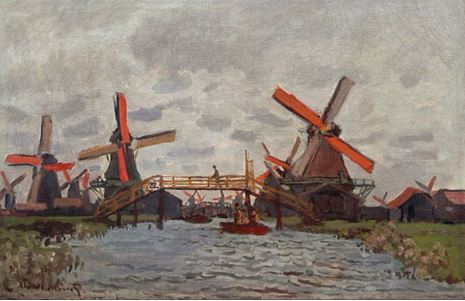
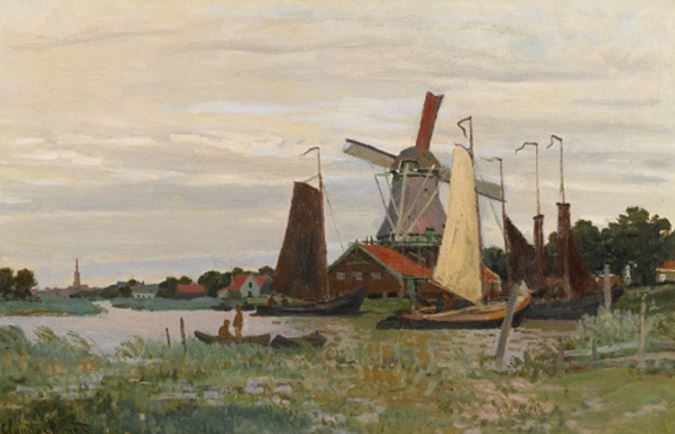
“Een zomers landschap” (“A summer landscape”), a painting by Jan van Os.
However, soon water and wind powered mills were
adapted to industrial processes like sawing wood, polishing glass, making
paper, boring pipes, cutting marble, slitting metal, sharpening knives,
crushing chalk, grinding mortar, making gunpowder, minting coins, and so on. [1-3]
Wind- and water mills also processed a host of agricultural products. They were
pressing olives, hulling barley and rice, grinding spices and tobacco, and
crushing linseed, rapeseed and hempseed for cooking and lighting.
Even though it relied on intermittent
wind sources, international trade was crucial to many European economies before
the Industrial Revolution.
So-called ‘industrial water mills’ had been used in
Antiquity and were widely adopted in Europe by the fifteenth century, but
‘industrial windmills’ appeared only in the 1600s in the Netherlands, a country
that took wind power to the extreme. The Dutch even applied wind power to
reclaim land from the sea, and the whole country was kept dry by intermittently
operating wind mills until 1850. [1-3]
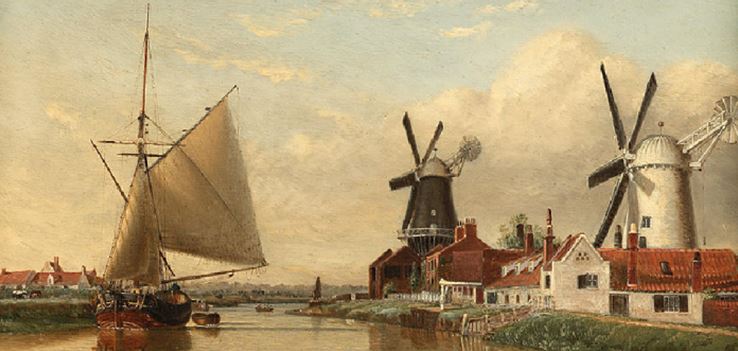
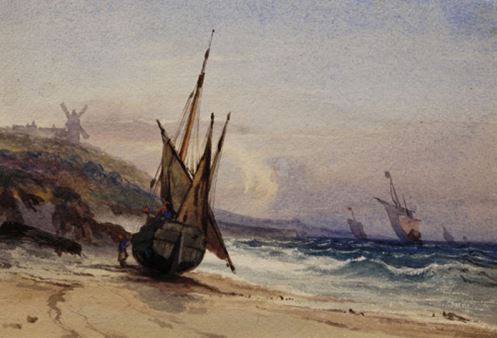
Abraham Storck: A river landscape with fishermen in rowing boats, 1679.
The use of wind power for transportation – in the
form of the sailboat – also boomed from the 1500s onwards, when Europeans
‘discovered’ new lands. Wind powered transportation supported a robust, diverse
and ever expanding international trading system in both bulk goods (such as
grain, wine, wood, metals, ceramics, and preserved fish), luxury items
(such as precious metals, furs, spices, ivory, silks, and medicin) and human
slaves. [4]
Even though it relied on intermittent wind sources,
international trade was crucial to many European economies. For example, the
Dutch shipbuilding industry, which was centred around some 450 wind-powered saw
mills, imported virtually all its naval stores from the Baltic: wood, tar,
iron, hemp and flax. Even the food supply could depend on wind-powered
transportation. Towards the end of the 1500s, the Dutch imported two
thousand shiploads of grain per year from Gdansk. [4]
Sailboats were also important for fishing.
Dealing with Intermittency in
Pre-Industrial Times
Although variable renewable energy sources were
critical to European society for some 500 years before fossil fuels took over,
there were no chemical batteries, no electric transmission lines, and no
balancing capacity of fossil fuel power plants to deal with the variable energy
output of wind and water power. So, how did our ancestors deal
with the large variability of renewable power sources?
To some extent, they were counting on technological
solutions to match energy supply to energy demand, just as we do today. The
water level in a river depends on the weather and the seasons. Boat mills and bridge mills were
among the earliest technological fixes to this problem. They went up and down
with the water level, which allowed them to maintain a more predictable
operating regime. [1-2]
To some extent, our ancestors were
counting on technological solutions to match energy supply to energy demand,
just as we do today.
However, water power could also be stored for later
use. Starting in the middle ages, dams were built to create mill ponds, a form
of energy storage that’s similar to today’s hydropower reservoirs. The storage
reservoirs evened out the flow of streams and insured that water was available
when it was needed. [2] [5]
The Horse Mill, a painting by James Herring. Ca. 1850.
But rivers could still dry out or freeze over for
prolonged periods, rendering dams and adjustable water wheels useless.
Furthermore, when one counted on windmills, no such technological fixes were
available. [3] [6-7]
A technological solution to the intermittency of
both water and wind power was the ‘beast mill’ or ‘horse mill’. [8] In
contrast to wind and water power, horses, donkeys or oxen could be counted on
to supply power whenever it was required. However, beast mills were
expensive and energy inefficient to operate: feeding a horse required a land
area capable of feeding eight humans. [9] Consequently, the use of animal
power in large-scale manufacturing processes was rare. Beast mills were mostly
used for the milling of grain or as a power source in small workshop settings,
using draft animals. [1]
Obviously, beast mills were not a viable backup
power source for sailing ships either. In principle, sailing boats could revert
to human power when wind was not available. However, a sufficiently large
rowing crew needed extra water and food, which would have limited the range of
the ship, or its cargo capacity. Therefore, rowing was mainly restricted to
battleships and smaller boats.
Adjusting Demand to Supply: Factories
Because of their limited technological options for
dealing with the variability of renewable energy sources, our ancestors mainly
resorted to a strategy that we have largely forgotten about: they adapted their
energy demand to the variable energy supply. In other words, they accepted that
renewable energy was not always available and acted accordingly. For example,
windmills and sailboats were simply not operated when there was no wind.
In industrial windmills, work was done whenever the
wind blew, even if that meant that the miller had to work night and day, taking
only short naps. For example, a document reveals that at the Union Mill in
Cranbrook, England, the miller once had only three hours sleep during a windy
period lasting 60 hours. [3] A 1957 book about windmills, partly based on
interviews with the last surviving millers, reveals the urgency of using wind
when it was available:
Often enough when the wind blew in autumn, the
miller would work from Sunday midnight to Tuesday evening, Wednesday morning to
Thursday night, and Friday morning to Saturday midnight, taking only a few
snatches of sleep; and a good windmiller always woke up in bed when the wind
rose, getting up in the middle of the night to set the mill going, because the
wind was his taskmaster and must be taken advantage of whenever it blew. Many a
village has at times gone short of wheaten bread because the local mill was
becalmed in a waterless district before the invention of the steam engine; and
barley-meal bread or even potato bread had to suffice in the crisis of a
windless autumn. [10]
In earlier, more conservative times, the miller was
punished for working on Sunday, but he didn’t always care. When a protest
against Sunday work was made to Mr. Wade of Wicklewood towermill, Norfolk, he
retorted: “If the Lord is good enough to send me wind on a Sunday, I’m
going to use it”. [11] On the other hand, when there was no wind,
millers did other work, like maintaining their machinery, or took time off.
Noah Edwards, the last miller of Arkley tower mill, Hertfordshire, would “sit
on the fan stage of a fine evening and play his fiddle”. [11]
Adjusting Demand to Supply: Sailboats
A similar approach existed for overseas travel,
using sail boats. When there was no wind, sailors stayed ashore, maintained and
repaired their ships, or did other things. They planned their trips according
to the seasons, making use of favourable seasonal winds and currents. Winds at
sea are not only much stronger than those over land, but also more predictable.
Sailors planned their trips according
to the seasons, making use of favourable seasonal winds and currents.
The lower atmosphere of the planet is encircled by
six major wind belts, three in each hemisphere. From Equator to poles these
‘prevailing winds’ are the trade winds, the westerlies, and the easterlies. The
six wind belts move north in the northern summer and south in the northern
winter. Five major sea current gyres are correlated with the dominant wind
flows.
The Maas at Dordrecht, a painting by Aelbert Cuyp, 1660.
Gradually, European sailors deciphered the global
pattern of winds and currents and took full advantage of them to establish new
sea routes all over the world. By the 1500s, Christopher Columbus had figured
out that the combination of trade winds and westerlies enabled a
round-trip route for sailing ships crossing the Atlantic Ocean.
The trade winds reach their northernmost latitude
at or after the end of the northern summer, bringing them in reach of Spain and
Portugal. These summer trade winds made it easy to sail from Southern
Europe to the Caribbean and South America, because the wind was blowing in that
direction along the route.
Wind map of the Atlantic, September 9, 2017. Source: Windy.
Taking the same route back would be nearly
impossible. However, Iberian sailors first sailed north to catch the
westerlies, which reach their southernmost location at or after the end of
winter and carried the sailors straight back to Southern Europe. In the 1560s,
Basque explorer Andrés de Urdaneta discovered a similar round-trip route in the
Pacific Ocean. [12]
The use of favourable winds made
travel times of sailboats relatively reliable. The fastest Atlantic crossing
was 21 days, the slowest 29 days.
The use of favourable winds made the travel times
of sailboats relatively predictable. Ocean Passages for the Worldmentions
that typical passage times from New York to the English Channel for a mid-19th
to early 20th century sailing vessel was 25 to 30 days. From 1818 to 1832, the
fastest crossing was 21 days, the slowest 29 days. [13]
The journey from the English Channel to New York
took 35-40 days in winter and 40-50 days in summer. To Cape Town, Melbourne,
and Calcutta took 50-60 days, 80-90 days, and 100-120 days, respectively. [13]
These travel times are double to triple those of today’s container ships,
which vary
their speed based on oil prices and economic demand.
Old Approach, New Technology
As a strategy to deal with variable energy sources,
adjusting energy demand to renewable energy supply is just as valuable a
solution today as it was in pre-industrial times. However, this does not
mean that we need to go back to pre-industrial means. We have better technology
available, which makes it much easier to synchronise the economic demands with
the vagaries of the weather.
Shipping in a calm, a painting by Charles Brooking, first half 18th century.
In the following paragraphs, I investigate in more
detail how industry and transportation could be operated on variable energy
sources alone, and demonstrate how new technologies open new possibilities. I
then conclude by analysing the effects on consumers, workers, and economic
growth.
Industrial Manufacturing
On a global scale, industrial manufacturing
accounts for nearly half of all energy end use. Many mechanical processes that
were run by windmills are still important today, such as sawing, cutting,
boring, drilling, crushing, hammering, sharpening, polishing, milling, turning,
and so on. All these production processes can be run with an intermittent power
supply.
The same goes for food production processes
(mincing, grinding or hulling grains, pressing olives and seeds), mining and excavation
(picking and shovelling, rock and ore crushing), or textile production (fulling
cloth, preparing fibres, knitting and weaving). In all these examples,
intermittent energy input does not affect the quality of the production
process, only the production speed.
Many production processes are not
strongly disadvantaged by an intermittent power supply.
Running these processes on variable power sources
has become a lot easier than it was in earlier times. For one thing, wind power
plants are now completely automated, while the traditional windmill required
constant attention. [14]
Image: “Travailler au moulin / Werken met molens”, Jean Bruggeman, 1996.
However, not only are wind turbines (and water
turbines) more practical and powerful than in earlier times, we can now make
use of solar energy to produce mechanical energy. This is usually done
with solar photovoltaic (PV) panels, which convert sunlight into electricity to
run an electric motor.
Consequently, a factory that requires mechanical
energy can be run on a combination of wind and solar power, which increases the
chances that there’s sufficient energy to run its machinery. The ability
to harvest solar energy is important because it’s by far the most widely
available renewable power source. Most of the potential capacity for water
power is already taken. [15]
Thermal Energy
Another crucial difference with pre-industrial
times is that we can apply the same strategy to basic industrial processes that
require thermal energy instead of mechanical energy. Heat dominates industrial
energy use, for instance, in the making of chemicals or microchips, or in the
smelting of metals.
In pre-industrial times, manufacturing processes
that required thermal energy were powered by the burning of biomass, peat
and/or coal. The use of these energy sources caused grave problems, such
as large-scale
deforestation, loss of land, and air pollution.
Although solar energy was used in earlier times, for instance, to evaporate
salt along seashores, to dry crops for preservation, or to sunbake clay bricks,
its use was limited to processes that required relatively low temperatures.
We can apply the same strategy to
basic industrial processes that require thermal energy instead of mechanical
energy, which was not possible before the Industrial Revolution.
Today, renewable energy other than biomass can be
used to produce thermal energy in two ways. First, we can use wind turbines,
water turbines or solar PV panels to produce electricity, which can then be
used to produce heat by electrical resistance. This was not possible in
pre-industrial times, because there was no electricity.
Augustin Mouchot’s solar powered printing press, 1882.
Second, we can apply solar heat directly, using
water-based flat plate collectors or evacuated tube collectors, which collect
solar radiation from all directions and can reach temperatures of 120 degrees
celsius. We also have solar concentrator collectors, which track the sun,
concentrate its radiation, and can generate temperatures high
enough to melt metals or produce microchips and solar cells. These
solar technologies only became available in the late 19th century, following
advances in the manufacturing of glass and mirrors.
Limited Energy Storage
Running factories on variable power sources doesn’t
exclude the use of energy storage or a backup of dispatchable power plants.
Adjusting demand to supply should take priority, but other
strategies can play a supportive role. First, energy
storage or backup power generation capacity could be useful for critical
production processes that can’t be halted for prolonged periods, such as food
production.
Second, short-term energy storage is also useful to
run production processes that are disadvantaged by an intermittent power
supply. [16] Third, short-term energy storage is crucial for
computer-controlled manufacturing processes, allowing these to continue
operating during short interruptions in the power supply, and to shut down
safely in case of longer power cuts. [17]
Binnenshaven Rotterdam, a painting by Jongkind Johan Berthold (1857)
Compared to pre-industrial times, we now have more
and better energy storage options available. For example, we can use biomass as
a backup power source for mechanical energy production, something
pre-industrial millers could not do – before the arrival of the steam engine,
there was no way of converting biomass into mechanical energy.
Before the arrival of the steam
engine, there was no way of converting biomass into mechanical energy.
We also have chemical batteries, and we have
low-tech systems like flywheels, compressed air storage, hydraulic
accumulators, and pumped storage plants. Heat energy can be stored in
well-insulated water reservoirs (up to 100 degrees) or in salt, oil or ceramics
(for much higher temperatures). All these storage solutions would fail for some
reason or another if they were tasked with storing a large share of renewable
energy production. However, they can be very useful on a smaller scale in
support of demand adjustment.
The New Age of Sail
Cargo transportation is another candidate for using
renewable power when it’s available. This is most obvious for shipping. Ships
still carry about 90 percent of the world’s trade, and although shipping is the
most energy efficient way of transportation per tonne-kilometre, total energy
use is high and today’s oil powered vessels are extremely polluting.
Image by Arne List [CC BY-SA 2.0], via Wikimedia Commons 12
A common high-tech idea is to install wind turbines
off-shore, convert the electricity they generate into hydrogen, and then use
that hydrogen to power seagoing vessels. However, it’s much more practical and
energy efficient to use wind to power ships directly, like we have done for
thousands of years. Furthermore, oil powered cargo ships often float idle
for days or even weeks before they can enter a port or leave it, which makes
the relative unpredictability of sailboats less problematic.
It’s much more practical and energy
efficient to use wind to power ships directly.
As with industrial manufacturing, we now have much
better technology and knowledge available to base a worldwide shipping industry
on wind power alone. We have new materials to build better and
longer-lasting ships and sails, we have more accurate navigation and
communication instruments, we have more predictable weather forecasts,
we can make use of solar panels for backup engine power, and we have more
detailed knowledge about winds and currents.
Thomas W. Lawson was a seven-masted, stell-hulled schooner built in 1902 for the Pacific trade. It had a crew of 18.
In fact, the global wind and current patterns were
only fully understood when the age of sail was almost over. Between 1842 and
1861, American navigator Matthew Fontaine Maury collected an extensive array of
ship logs which enabled him to chart prevailing winds and sea currents, as well
as their seasonal variations. [18]
Maury’s work enabled seafarers to shorten sailing
time considerably, by simply taking better advantage of prevailing winds and
sea currents. For instance, a journey from New York to Rio de Janeiro was
reduced from 55 to 23 days, while the duration of a trip from Melbourne to
Liverpool was halved, from 126 to 63 days. [18]
More recently, yacht racing has generated many innovations
that have never been applied to commercial shipping. For example, in the 2017
America’s Cup, the Emirates Team New Zealand introduced stationary bikes
instead of hand cranks to power the hydraulic system that steers the boat.
Because our legs are stronger than our arms, pedal powered ‘grinding’ allows
for quicker tacking and gybing in a race, but it could also be useful to reduce
the required manpower for commercial sailing ships. [19]
Speed sailing records are also telling. The fastest
sailboat in 1972 did not even reach 50 km/h, while the current record holder —
the Vestas Sailrocket 2 — sailed at 121 km/h in 2012. While these types of
ships are not practical to carry cargo, they could inspire other designs that
are.
Wind & Solar Powered Trains
We could follow a similar approach for land-based
transportation, in the form of wind and solar powered trains. Like sailing
boats, trains could be running whenever there is renewable energy available.
Not by putting sails on trains, of course, but by running them on electricity
made by solar PV panels or wind turbines along the tracks. This would be an
entirely new application of a centuries-old strategy to deal with variable
energy sources, only made possible by the invention of electricity.
Wind and solar powered trains would
be an entirely new application of a centuries-old strategy to deal with
variable energy sources.
Running cargo trains on renewable energy is a great
use of intermittent wind power because they are usually operated at night, when
wind power is often at its best and energy demand is at its lowest.
Furthermore, just like cargo ships, cargo trains already have unreliable
schedules because they often sit stationary in train-yards for days, waiting to
become fully loaded.
Cardiff Docks, a painting by Lionel Walden, 1894 15
Even the speed of the trains could be regulated by
the amount of renewable energy that is available, just as the wind speed
determines the speed of a sailing ship. A similar approach could also work with
other electrical transportation systems, such as trolleytrucks, trolleyboats or aerial
ropeways.
Combining solar and wind powered cargo trains with
solar and wind powered factories creates extra possibilities. For example, at
first sight, solar or wind powered passenger trains appear to be impossible,
because people are less flexible than goods. If a solar powered train is not
running or is running too slow, an appointment may have to be rescheduled at
the last minute. Likewise, on cloudy days, few people would make it to the
office.
Solar PV panels cover a railway in Belgium, 2016. Image: Infrabel.
However, this could be solved by using the same
renewable power sources for factories and passenger trains. Solar panels along
the railway lines could be sized for cloudy days, and thus guarantee a minimum
level of energy for a minimum service of passenger trains (but no industrial
production). During sunny days, the extra solar power could be used to run the
factories along the railway line, or to run extra passenger (or cargo) trains.
Consequences for Society: Consumption
& Production
As we’ve seen, if industrial production and cargo
transportation became dependent on the availability of renewable energy, we
would still be able to produce a diverse range of consumer goods, and
transport them all over the globe. However, not all products would be available
all the time. If I want to buy new shoes, I might have to wait for the right
season to get them manufactured and delivered.
Production and consumption would depend on the
weather and the seasons. Solar powered factories would have higher production
rates in the summer months, while wind powered factories would have higher
production rates in the winter months. Sailing seasons also need to be taken
into account.
If I want to buy new shoes, I might
have to wait for the right season to get them manufactured and delivered.
But running an economy on the rhythms of the
weather doesn’t necessarily mean that production and consumption rates would go
down. If factories and cargo transportation adjust their energy use to the
weather, they can use the full annual power production of wind turbines and
solar panels.
A Windmill at Zaandam, a painting by Claude Monet, 1871.
Manufacturers could counter seasonal production
shortages by producing items ‘in season’ and then stocking it close to
consumers for sale during low energy periods. In fact, the products themselves
would become ‘energy storage’ in this scenario. Instead of storing energy to
manufacture products in the future, we would manufacture products whenever
there is energy available, and store the products for later sale instead.
However, seasonal production may well lead to lower
production and consumption rates. Overproducing in high energy times requires
large production facilities and warehouses, which would be underused for
the rest of the year. To produce cost-efficiently, manufacturers will need to
make compromises. From time to time, these compromises will lead to product
shortages, which in turn could encourage people to consider other solutions,
such as repair and re-use of existing products, crafted products, DIY, or
exchanging and sharing goods.
Consequences for the Workforce
Adjusting energy demand to energy supply also
implies that the workforce adapts to the weather. If a factory runs on solar
power, then the availability of power corresponds very well with human rhythms.
The only downside is that workers would be free from work especially in winter
and on cloudy days.
However, if a factory or a cargo train runs on wind
power, then people will also have to work during the night, which is considered
unhealthy. The upside is that they would have holidays in summer and on good
weather days.
Nachtelijk werk in de dokken (Night work at the docks), a painting by Henri Adolphe Schaep, 1856.
If a factory or a transportation system is operated
by wind or solar energy alone, workers would also have to deal with uncertainty
about their work schedules. Although we have much better weather forecasts than
in pre-industrial times, it remains difficult to make accurate predictions more
than a few days ahead.
However, it is not only renewable power plants that
are now completely automated. The same goes for factories. The last century has
seen increasing automation of production processes, based on computers and
robots. So-called “dark factories” are already completely automated (they need
no lights because there is nobody there).
It’s not only renewable power plants
that are now completely automated. The same goes for factories.
If a factory has no workers, it doesn’t matter when
it’s running. Furthermore, many factories already run for 24 hours per day,
partly operated by millions of night shift workers. In these cases, night work
would actually decrease because these factories will only run through the night
if it’s windy.
Finally, we could also limit the main share of
industrial manufacturing and railway transportation to normal working hours,
and curtail the oversupply during the night. In this scenario, we would simply
have less material goods and more holidays. On the other hand, there would be
an increased need for other types of jobs, like craftsmanship and sailing.
What About the Internet?
In conclusion, industrial manufacturing and cargo
transportation — both over land and over sea — could be run almost entirely
on variable renewable power sources, with little need for energy storage,
transmission networks, balancing capacity or overbuilding renewable power
plants. In contrast, the modern high-tech approach of matching energy supply to
energy demand at all times requires a lot of extra infrastructure which makes
renewable power production a complex,
slow, expensive and unsustainable undertaking.
Adjusting energy demand to supply would make
switching to renewable energy much more realistic than it is today. There
would be no curtailment of energy, and no storage and transmission losses. All
the energy produced by solar panels and wind turbines would be used on the spot
and nothing would go to waste.
Marina, a painting by Carol Popp de Szathmary, 1800s. 19
Admittedly, adjusting energy demand to energy
supply can be less straightforward in other sectors. Although the internet
could be entirely operated on variable power sources — using asynchronous
networks and delay-tolerant software — many newer internet applications
would then disappear.
At home, we probably can’t expect people to sit in
the dark or not to cook meals when there is no renewable energy. Likewise,
people will not come to hospitals only on sunny days. In such instances, there
is a larger need for energy storage or other measures to counter an
intermittent power supply. That’s for a next post.
Kris De Decker. Edited by Jenna Collett.
Part of the research for this article happened
during a fellowship at the Demand Centre, Lancaster, UK.
Sources:
[1] Lucas, Adam. Wind, Water, Work:
Ancient and Medieval Milling Technology. Vol. 8. Brill, 2006.
[2] Reynolds, Terry S. Stronger than a
hundred men: a history of the vertical water wheel. Vol. 7. JHU Press,
2002.
[3] Hills, Richard Leslie. Power from wind:
a history of windmill technology. Cambridge University Press, 1996.
[4] Paine, Lincoln. The sea and
civilization: a maritime history of the world. Atlantic Books Ltd, 2014.
[5] One of the earliest large hydropower dams
was the Cento dam in Italy (1450), which was 71 m long and almost 6 m high. By
the 18th century, the largest dams were up to 260 m long and 25 m high, with
power canals leading to dozens of water wheels. [2]
[6] Although windmills had all kinds of
internal mechanisms to adapt to sudden changes in wind speed and wind
direction, wind power had no counterpart for the dam in water power.
[7] This explains why windmills became especially
important in regions with dry climates, in flat countries, or in very cold
areas, where water power was not available. In countries with good water
resources, windmills only appeared when the increased demand for power created
a crisis because the best waterpower sites were already occupied.
[8] Tide mills were technically similar to
water mills, but they were more reliable because the sea is less prone to dry
out, freeze over, or change its water level than a river.
[9] Sieferle, Rolf Peter, and Michael P.
Osman. The subterranean forest: energy systems and the industrial
revolution. Cambridge: White Horse Press, 2001.
[10] Freese, Stanley. Windmills and
millwrighting. Cambridge University Press, 1957
[11] Wailes, Rex. The English windmill.
London, Routledge & K. Paul, 1954
[12] The global wind pattern is complemented
by regional wind patterns, such as land and sea breezes. The Northern Indian
Ocean has semi-annually reversing Monsoon winds. These blow from the southwest
from June to November, and from the northeast from December to May. Maritime trade
in the Indian Ocean started earlier than in other seas, and the established
trade routes were entirely dependent on the season.
[13] Jenkins, H. L. C. “Ocean passages for the
world.” The Royal Navy, Somerset (1973).
[14] Windmillers had to be alert to keep the
gap between the stones constant however choppy the wind, and before the days of
the centrifugal governor this was done by hand. The miller had to watch the
power of the wind, to judge how much sail cloth to spread, and to be prepared
to stop the mill under sail and either take in or let out more cloth, for
there were no patent sails. And before the fantail came into use, he had to
watch the direction of the wind as well and keep the sails square into the
wind’s eye. [11]
[15] Apart from electricity, the Industrial
Revolution also brought us compressed air, water
under pressure, and improved
mechanical power transmission, which can all be valuable
alternatives for electricity in certain applications.
[16] A similar distinction was made in the old
days. For example, when spinning cloth, a constant speed was required to avoid
gearwheels hunting and causing the machines to deliver thick and thin parts in
rovings or yarns. [3] That’s why spinning was only mechanised using
water power, which could be stored to guarantee a more regular power supply, and
not wind power. Wind power was also unsuited for processes like papermaking,
mine haulage, or operating blast furnace bellows in ironworks.
[17] Very short-term energy storage is
required for many mechanical production processes running on variable power
sources, in order to smooth out small and sudden variations in energy supply.
Such mechanical systems were already used in pre-industrial windmills.
[18] Leighly, J. (ed) (1963) The Physical
Geography of the Sea and its Meteorology by Matthew Fontaine Maury, 8th
Edition, Cambridge, MA: Belknap Press. Cited by Knowles, R.D. (2006)
“Transport shaping space: the differential collapse of time/space”,
Journal of Transport Geography, 14(6), pp. 407-425.
February 29, 2012 , In Solar Power, with permission from LANDGENERATOR
The
history of renewable energy is fascinating. We posted a while back about
early efforts to harness the power of waves. You may also be interested to learn more about the
19th century work of Mouchot and Ericsson, early pioneers of solar thermal
concentrators (CSP solar thermal power).
Early schematics of Augustin Mouchot’s Solar Concentrator.
Augustin Mouchot taught
secondary school mathematics from 1852-1871, during which time he embarked on a
series of experiments in the conversion of solar energy into useful work. His proof-of-concept
designs were so successful that he obtained support from the French government
to pursue the research full-time. His work was inspired and informed by that of Horace-Bénédict de
Saussure(who had constructed the first successful solar oven in
1767) and Claude Pouillet (who
invented the Pyrheliometer in
1838).
Augustin Mouchot’s Solar Concentrator at the Universal Exhibition in Paris, 1878.
Mouchot
worked on his most ambitious device in the sunny conditions of French Algeria
and brought it back for demonstration at the Universal Exhibition in
Paris of 1878. There he won the Gold Medal, impressing the
judges with the production
of ice from the power of the sun.
Unfortunately,
the falling price of coal, driven by efficiencies of transport and free trade agreements
with Britain, meant that Mouchot’s work would soon be deemed
unnecessary and his funding was cut soon after his triumph at the Universal
Exhibition.
Abel Pifre and his solar powered printing press. Image from Scientific American, May 1882.
His
assistant, Abel Pifre,
would continue his work, however, and demonstrated a solar powered printing
press in the Jardin des Tuileries in 1882. Despite cloudy conditions that day,
the machine printed 500 copies per hour of Le Journal du
Soleil, a newspaper written specially for the demonstration.
John Ericsson’s Solar Engines
Meanwhile,
the great inventor and engineer John Ericsson had
decided to devote the last years of his life to similar pursuits. His work on
solar engines spanned the 1870s and 1880s. Instead of relying on steam, he
utilized his version of the heat engine, a
device that would prove very commercially successful when powered with more
conventional fuel sources such as gas.
“You
will probably be surprised when I say that the sun-motor is nearer perfection
than the steam-engine,” [Ericsson] wrote one friend, “but until coal mines are
exhausted its value will not be fully acknowledged.” He calculated that solar
power cost about ten times as much as coal, so that until coal began to run
out, solar power would not be economically feasible. But this, to him, was not
a sign of failure—there was no question that fossil fuels would indeed run out
someday.
The
great engineer maintained an unshakeable belief in the future of solar power to
his last breath; he had set up a large engine in his backyard and was still
perfecting it when he collapsed in early 1889. Though his doctor made him rest,
Ericsson could not sleep at night: he complained that he could not stop
thinking about his work yet to be done.
Both
Mouchot and Ericsson were driven by the prescient understanding that access to
coal, the predominant fossil fuel of the time, would eventually run out. And
while, new discoveries of petroleum and natural gas have extended our
inexpensive access to energy, we are finally now, 140 years later, reaching a
time when their predictions are coming true. For the wisdom behind the premise
is still as valid today as it was then—nothing that is finite can last forever.
These inventors were so far ahead of their time, it is almost scary.
Originally posted on the Archdruid Report now https://www.ecosophia.net/ by John Michael Greer, March 2014. Reprinted with permission of the author.
I have yet to hear anyone in the peak
oil blogosphere mention the name of Captain Gustaf Erikson of the Åland
Islands and his fleet of windjammers. For all I know, he’s been
completely forgotten now, his name and accomplishments packed away in the same
dustbin of forgotten history as solar steam-engine pioneer Augustin Mouchot,
his near contemporary. If so, it’s high time that his footsteps sounded again
on the quarterdeck of our collective imagination, because his story—and the
core insight that committed him to his lifelong struggle—both have plenty to
teach about the realities framing the future of technology in the wake of
today’s era of fossil-fueled abundance.
Erikson, born in 1872, grew up in a
seafaring family and went to sea as a ship’s boy at the age of nine. At 19 he
was the skipper of a coastal freighter working the Baltic and North Sea ports;
two years later he shipped out as mate on a windjammer for deepwater runs to
Chile and Australia, and eight years after that he was captain again, sailing
three- and four-masted cargo ships to the far reaches of the planet. A bad fall
from the rigging in 1913 left his right leg crippled, and he left the sea to
become a ship owner instead, buying the first of what would become the 20th
century’s last major fleet of wind powered commercial cargo vessels.
It’s too rarely remembered these days
that the arrival of steam power didn’t make commercial sailing vessels obsolete
across the board. The ability to chug along at eight knots or so without
benefit of wind was a major advantage in some contexts—naval vessels and
passenger transport, for example—but coal was never cheap, and the long
stretches between coaling stations on some of the world’s most important trade
routes meant that a significant fraction of a steamship’s total tonnage had to
be devoted to coal, cutting into the capacity to haul paying cargoes. For bulk
cargoes over long distances, in particular, sailing ships were a good deal more
economical all through the second half of the 19th century, and some runs
remained a paying proposition for sail well into the 20th.
That was the niche that the
windjammers of the era exploited. They were huge—up to 400 feet from stem to
stern—square-sided, steel-hulled ships, fitted out with more than an acre of
canvas and miles of steel-wire rigging. They could be crewed by a
few dozen sailors, and hauled prodigious cargoes: up to 8,000 tons
of Australian grain, Chilean nitrate—or, for that matter, coal; it was among
the ironies of the age that the coaling stations that allowed steamships to
refuel on long voyages were very often kept stocked by tall ships, which could
do the job more economically than steamships themselves could. The markets
where wind could outbid steam were lucrative enough that at the beginning of
the 20th century, there were still thousands of working windjammers hauling cargoes
across the world’s oceans.
That didn’t change until bunker oil
refined from petroleum ousted coal as the standard fuel for powered ships.
Petroleum products carry much more energy per pound than even the best grade of
coal, and the better grades of coal were beginning to run short and rise
accordingly in price well before the heyday of the windjammers was over. A
diesel-powered vessel had to refuel less often, devote less of its tonnage to
fuel, and cost much less to operate than its coal-fired equivalent. That’s why
Winston Churchill, as head of Britain’s Admiralty, ordered the entire British
Navy converted from coal to oil in the years just before the First World War,
and why coal-burning steamships became hard to find anywhere on the seven seas
once the petroleum revolution took place. That’s also why most windjammers went
out of use around the same time; they could compete against coal, but not
against dirt-cheap diesel fuel.
Gustav Erikson went into business as
a ship owner just as that transformation was getting under way. The rush to
diesel power allowed him to buy up windjammers at a fraction of their former
price—his first ship, a 1,500-ton bark, cost him less than $10,000, and the
pride of his fleet, the four-masted Herzogin Cecilie, set him back
only $20,000. A tight rein on operating expenses and a careful eye
on which routes were profitable kept his firm solidly in the black. The bread
and butter of his business came from shipping wheat from southern Australia to
Europe; Erikson’s fleet and the few other windjammers still in the running
would leave European ports in the northern hemisphere’s autumn and sail for
Spencer Gulf on Australia’s southern coast, load up with thousands of tons of
wheat, and then race each other home, arriving in the spring—a good skipper
with a good crew could make the return trip in less than 100 days, hitting
speeds upwards of 15 knots when the winds were right.
There was money to be made that way,
but Erikson’s commitment to the windjammers wasn’t just a matter of profit. A
sentimental attachment to tall ships was arguably part of the equation, but
there was another factor as well. In his latter years, Erikson was fond of
telling anyone who would listen that a new golden age for sailing ships was on
the horizon: sooner or later, he insisted, the world’s supply of
coal and oil would run out, steam and diesel engines would become so many lumps
of metal fit only for salvage, and those who still knew how to haul freight
across the ocean with only the wind for power would have the seas, and the
world’s cargoes, all to themselves.
Those few books that mention Erikson
at all like to portray him as the last holdout of a departed age, a man born
after his time. On the contrary, he was born before his time, and lived too soon.
When he died in 1947, the industrial world’s first round of energy crises were
still a quarter century away, and only a few lonely prophets had begun to grasp
the absurdity of trying to build an enduring civilization on the
ever-accelerating consumption of a finite and irreplaceable fuel supply. He had
hoped that his sons would keep the windjammers running, and finish the task of
getting the traditions and technology of the tall ships through the age of
fossil fuels and into the hands of the seafarers of the future. I’m sorry to
say that that didn’t happen; the profits to be made from modern freighters were
too tempting, and once the old man was gone, his heirs sold off the windjammers
and replaced them with diesel-powered craft.
Erikson’s story is worth remembering,
though, and not simply because he was an early prophet of what we now call peak
oil. He was also one of the very first people in our age to see past the
mythology of technological progress that dominated the collective imagination
of his time and ours, and glimpse the potentials of one of the core strategies
this blog has been advocating for the last eight years.
We can use the example that would
have been dearest to his heart, the old technology of windpowered maritime
cargo transport, to explore those potentials. To begin with, it’s crucial to
remember that the only thing that made tall ships obsolete as a transport
technology was cheap abundant petroleum. The age of coal-powered steamships
left plenty of market niches in which windjammers were economically more viable
than steamers. The difference, as already noted, was a matter of
energy density—that’s the technical term for how much energy you get out of
each pound of fuel; the best grades of coal have only about half the energy
density of petroleum distillates, and as you go down the scale of coal grades,
energy density drops steadily. The brown coal that’s commonly used
for fuel these days provides, per pound, rather less than a quarter the heat
energy you get from a comparable weight of bunker oil.
As the world’s petroleum reserves
keep sliding down the remorseless curve of depletion, in turn, the price of
bunker oil—like that of all other petroleum products—will continue to move
raggedly upward. If Erikson’s tall ships were still in service, it’s quite
possible that they would already be expanding their market share; as it is,
it’s going to be a while yet before rising fuel costs will make it economical
for shipping firms to start investing in the construction of a new generation of
windjammers. Nonetheless, as the price of bunker oil keeps rising,
it’s eventually going to cross the line at which sail becomes the more
profitable option, and when that happens, those firms that invest in tall ships
will profit at the expense of their old-fahioned, oil-burning rivals.
Yes, I’m aware that this last claim
flies in the face of one of the most pervasive superstitions of our time, the
faith-based insistence that whatever technology we happen to use today must
always and forever be better, in every sense but a purely sentimental one, than
whatever technology it replaced. The fact remains that what made diesel-powered
maritime transport standard across the world’s oceans was not some abstract
superiority of bunker oil over wind and canvas, but the simple reality that for
a while, during the heyday of cheap abundant petroleum,
diesel-powered freighters were more profitable to operate than any of the other
options. It was always a matter of economics, and as petroleum depletion
tilts the playing field the other way, the economics will change accordingly.
All else being equal, if a shipping
company can make larger profits moving cargoes by sailing ships than by diesel
freighters, coal-burning steamships, or some other option, the sailing ships will
get the business and the other options will be left to rust in port. It really
is that simple. The point at which sailing vessels become economically viable,
in turn, is determined partly by fuel prices and partly by the cost of building
and outfitting a new generation of sailing ships. Erikson’s plan was to do an
end run around the second half of that equation, by keeping a working fleet of
windjammers in operation on niche routes until rising fuel prices made it
profitable to expand into other markets. Since that didn’t happen, the lag time
will be significantly longer, and bunker fuel may have to price itself entirely
out of certain markets—causing significant disruptions to maritime trade and to
national and regional economies—before it makes economic sense to start
building windjammers again.
It’s a source of wry amusement to me
that when the prospect of sail transport gets raised, even in the greenest of
peak oil circles, the immediate reaction from most people is to try to find
some way to smuggle engines back onto the tall ships. Here again, though, the
issue that matters is economics, not our current superstitious reverence for
loud metal objects. There were plenty of ships in the 19th century that
combined steam engines and sails in various combinations, and plenty of ships
in the early 20th century that combined diesel engines and sails the same
way. Windjammers powered by sails alone were more economical than
either of these for long-range bulk transport, because engines and their fuel
supplies cost money, they take up tonnage that can otherwise be used for paying
cargo, and their fuel costs cut substantially into profits as well.
For that matter, I’ve speculated in
posts here about the possibility that Augustin Mouchot’s solar steam engines, or
something like them, could be used as a backup power source for the windjammers
of the de-industrial future. It’s interesting to note that the use of renewable
energy sources for shipping in Erikson’s time wasn’t limited to the motive
power provided by sails; coastal freighters of the kind Erikson skippered when
he was nineteen were called “onkers” in Baltic Sea slang, because their
windmill-powered deck pumps made a repetitive “onk-urrr, onk-urrr” noise.
Still, the same rule applies; enticing as it might be to imagine sailors on a
becalmed windjammer hauling the wooden cover off a solar steam generator,
expanding the folding reflector, and sending steam down belowdecks to drive a
propeller, whether such a technology came into use would depend on whether the
cost of buying and installing a solar steam engine, and the lost earning
capacity due to hold space being taken up by the engine, was less than the
profit to be made by getting to port a few days sooner.
Are there applications where engines
are worth having despite their drawbacks? Of course. Unless the price of
biodiesel ends up at astronomical levels, or the disruptions ahead along the
curve of the Long Descent cause diesel technology to be lost entirely, tugboats
will probably have diesel engines for the imaginable future, and so will naval
vessels; the number of major naval battles won or lost in the days of sail
because the wind blew one way or another will doubtless be on the minds of many
as the age of petroleum winds down. Barring a complete collapse in technology,
in turn, naval vessels will no doubt still be made of steel—once cannons
started firing explosive shells instead of solid shot, wooden ships became
deathtraps in naval combat—but most others won’t be; large-scale steel
production requires ample supplies of coke, which is produced by roasting coal,
and depletion of coal supplies in a postpetroleum future guarantees that steel
will be much more expensive compared to other materials than it is today, or
than it was during the heyday of the windjammers.
Note that here again, the limits to
technology and resource use are far more likely to be economic than technical.
In purely technical terms, a maritime nation could put much of its arable land
into oil crops and use that to keep its merchant marine fueled with biodiesel.
In economic terms, that’s a nonstarter, since the advantages to be gained by it
are much smaller than the social and financial costs that would be imposed by
the increase in costs for food, animal fodder, and all other agricultural products.
In the same way, the technical ability to build an all-steel merchant fleet
will likely still exist straight through the de-industrial future; what won’t exist is the ability to do
so without facing prompt bankruptcy. That’s what happens when you have to live
on the product of each year’s sunlight, rather than drawing down half a billion
years of fossil photosynthesis: there are hard economic limits to
how much of anything you can produce, and increasing production of one thing
pretty consistently requires cutting production of something else. People in
today’s industrial world don’t have to think like that, but their descendants
in the de-industrial world will either
learn how to do so or perish.
This point deserves careful study, as
it’s almost always missed by people trying to think their way through the
technological consequences of the de-industrial future. One reader of mine who objected to
talk about abandoned technologies in a previous post quoted with approval the
claim, made on another website, that if a de-industrial society can make one gallon of biodiesel, it
can make as many thousands or millions of gallons as it
wants. Technically, maybe; economically, not a
chance. It’s as though you made $500 a week and someone claimed you
could buy as many bottles of $100-a-bottle scotch as you wanted; in any given
week, your ability to buy expensive scotch would be limited by your need to
meet other expenses such as food and rent, and some purchase plans would be out
of reach even if you ignored all those other expenses and spent your entire
paycheck at the liquor store. The same rule applies to societies that don’t
have the windfall of fossil fuels at their disposal—and once we finish burning
through the fossil fuels we can afford to extract, every human society for the
rest of our species’ time on earth will be effectively described in those
terms.
The one readily available way around
the harsh economic impacts of fossil fuel depletion is the one that Gunnar
Erikson tried, but did not live to complete—the strategy of keeping an older
technology in use, or bringing a defunct technology back into service, while
there’s still enough wealth sloshing across the decks of the industrial economy
to make it relatively easy to do so. I’ve suggested above that if
his firm had kept the windjammers sailing, scraping out a living on whatever
narrow market niche they could find, the rising cost of bunker oil might
already have made it profitable to expand into new niches; there wouldn’t have
been the additional challenge of finding the money to build new windjammers
from the keel up, train crews to sail them, and get ships and crews through the
learning curve that’s inevitably a part of bringing an unfamiliar technology on
line.
That same principle has been central
to quite a few of this blog’s projects. One small example is the encouragement
I’ve tried to give to the rediscovery of the slide rule as an effective
calculating device. There are still plenty of people alive today who know how
to use slide rules, plenty of books that teach how to crunch numbers with a
slipstick, and plenty of slide rules around. A century down the line, when
slide rules will almost certainly be much more economically viable than pocket
calculators, those helpful conditions might not be in place—but if people take
up slide rules now for much the same reasons that Erikson kept the tall ships
sailing, and make an effort to pass skills and slipsticks on to another
generation, no one will have to revive or reinvent a dead technology in order
to have quick accurate calculations for practical tasks such as engineering,
salvage, and renewable energy technology.
The collection of sustainable-living
skills I somewhat jocularly termed “green wizardry,” which I learned back in
the heyday of the appropriate tech movement in the late 1970s and early 1980s,
passed on to the readers of this blog in a series of posts a couple of years
ago, and have now explored in book form as well, is another case in point. Some of
that knowledge, more of the attitudes that undergirded it, and nearly all the
small-scale, hands-on, basement-workshop sensibility of the movement in
question has vanished from our collective consciousness in the years since the
Reagan-Thatcher counterrevolution foreclosed any hope of a viable future for
the industrial world. There are still enough books on appropriate tech
gathering dust in used book shops, and enough in the way of living memory among
those of us who were there, to make it possible to recover those things;
another generation and that hope would have gone out the window.
There are plenty of other
possibilities along the same lines. For that matter, it’s by no means
unreasonable to plan on investing in technologies that may not be able to
survive all the way through the decline and fall of the industrial age, if
those technologies can help cushion the way down. Whether or not it will still
be possible to manufacture PV cells at the bottom of the de-industrial dark
ages, as I’ve been pointing out since
the earliest days of this blog,
getting them in place now on a home or local community scale is likely to pay
off handsomely when grid-based electricity becomes unreliable, as it
will. The modest amounts of electricity you can expect to get from
this and other renewable sources can provide critical services (for example,
refrigeration and long-distance communication) that will be worth having as the
Long Descent unwinds.
That said, all such strategies depend on having
enough economic surplus on hand to get useful technologies in place before the
darkness closes in. As things stand right now, as many of my readers will have
had opportunity to notice already, that surplus is trickling away. Those of us
who want to help make a contribution to the future along those lines had better
get a move on.
Melding 19th and 21st Century
Technologies for Waterborne Freight and Passenger Transport
Our world is now convulsed by three great converging crises: climate change, global economic instability, and peak everything. Add to these principal threats the risks of wars over natural resources, climate migration, the total failure of aging and over stressed infrastructure, and the erosion of traditional community values. Each of these crises presents particularly thorny problems for the New York City Metropolitan area and the Hudson Valley Bio-region.
Our region is at a crossroads. Looking
forward rationally at all the indicators, the “business as usual” choice takes
us down a road to cataclysmic energy shortages and infrastructure failure, to
inundation from sea level rise, to financial meltdown and its attendant social
disarray.
There are four possible response strategies:
Denial – waiting and hoping that some unforeseen miracle will solve the problem
Last One Standing – global competition and warfare to control all remaining resources;
Power Down down – global cooperation to reduce energy use, conserve and manage resources, while reducing population; and
Today the far-flung international trade network that once pumped vibrant economic life into the region threatens to collapse as imported natural resources, pollution from shipping, and the fossil fuels needed to transport goods will soon become increasingly scarce and expensive. Higher petroleum costs, and turmoil in countries in which much of our imported goods are made could snap that lifeline. The present system is unsustainable.
The rivers, bays, canals, and coasts of the Hudson Valley, NY Harbor,
and Mid-Atlantic continue to be a marine highway, but one that is limited to
deeply dredged channels leading to container ports and fossil fuel and chemical
tank farms. Traffic consists of the movement of consumer goods,
automobiles, and spirits from around the world on large ocean going fossil
fueled container ships to ports where the containers are loaded onto trucks for
delivery to warehouses for distribution in a “just in time” logistics
system.
Moving goods and people from place to place in a carbon constrained future will be dependent on sailing vessels, hybrid/fossil free electric ships, and people, bicycle, and animal powered transport for first and last mile logistics. These methods of transport will meld 19th and 21st Century Technology. Ships will be (re)built locally from locally sourced or recycled materials and will be crewed by locally trained seafarers. The ships will provide a carbon neutral trading link, will be a laboratory for innovation and competitiveness, will be commercially competitive with conventional fossil fuel transport in certain markets, will operate on reliable schedules (dependent on tide, wind, and weather), and offer competitive freight rates on appropriate routes.
This executive summary of a monologue in support of the Center for Post Carbon Logistics (The Center) includes a plan for Hudson Valley/Mid-Atlantic river bay, coastal, and ocean shipping of fair trade cargo. The time is right and an opportunity exists now to reinvent and profit from low carbon cargo delivery. Post carbon ships have many advantages over larger oil powered cargo ships. Sailing and alternative fuel freighters can locally promote:
job creation in farming,
logistics, ship building and maintenance among others
Revitalization of
waterfront communities by preserving the working waterfront and commercial
enterprises, while providing more public access, and recreation.
Food production and distribution, and connecting
producers to buyers
The mission of the Center for Post Carbon Logistics is to provide the pragmatic means to survive the decades ahead and to provide the tools to transition to a more resilient, equitable, and sustainable world. The Center will do so by providing individuals and communities with no-nonsense methods of transitioning away from the use of fossil fuels for transporting goods and passengers. The Center will research and assist in the implementation of appropriate or Slow Technology[1] needed to respond to the inevitable equity, economic, ecological, and energy crises of the 21st century.
The idea of Slow Technology or “Slow Tech” has its roots in the ideological movement called “appropriate technology,” a term coined by E.F. Schumacher in his book Small is Beautiful, first published in 1973. Slow Tech should be thoughtful about how devices shape our relationships to time, emotion, energy, and bioregional environment.
The Center will house a widely
accessible traditional knowledge data base, library, and a pre/post carbon
tool, technology, and machinery collection.
The Center will promote Slow
Technology
The Center will be an advocate for
existing and emerging low carbon shipping and post carbon transportation
businesses..
The Center will provide educational
opportunities and creative, implementable, real world solutions to the
environmental, economic, and social crises we are likely to face in the near
and mid-term future.
The Center will enable people to work
locally to transition our communities and bioregion away from a fossil
fuel-based economy to a “restorative economy,” one that is human-scaled,
embraces alternative locally based energy, and that is less extractive.
The Center will host regional,
national, and international conferences on post carbon logistics and sail
freight and will be an advocate for working waterfronts throughout the Canals,
the Hudson Valley, NY Harbor, and the Atlantic Coast.
The Center will partner with other
enterprises and organizations to provide a physical place where professional
practitioners and apprentices can participate in theory and practice workshops
for preserving the skills of the past to serve the future.
The Center will advocate for a
Transition that people will embrace it as a collective adventure, as a common
journey, as something positive, and how communities can feel alive, positive
and included in this process of societal transformation. Paraphrasing the title
of Transition Town Rob Hopkins’ book, The Center for Post Carbon Logistics will
be the embodiment of the “Power of Just Doing Stuff.”
Kingston, NY as well as, every community along the Canals, the Hudson
River, NY Harbor and the North East US Coast will have to engage its collective
creativity to unleash an extraordinary and historic transition to a
future beyond fossil fuels; a future that is more vibrant, abundant and resilient; one that is
ultimately preferable to the present.