By Rik van Hemmen, Vice President and Partner, MARTIN, OTTAWAY, van HEMMEN & DOLAN, INC., Originally published in Surveyors Notebook. © 2026 Martin, Ottaway, van Hemmen & Dolan, Inc. Rik is a member of the Board of Directors of the Center for Post Carbon Logistics, Inc.
Maritime transportation takes advantage of huge economies of scale, but it was not always that way. Even quite recently there were many maritime ventures in the United States that operated on quite a small scale and in certain places in the world maritime transportation still takes place on very small scales down to the canoe level.
Economies of scale are a complex subject. While the per pound, or per passenger, costs go down with economies of scale, almost inevitably there is something or someone that is left behind. In the past there was a strong connection between maritime at large and the public, but today, due to these economy of scale efficiencies, that connection has been mostly lost.
Our waterways inherently have low greenhouse gas emission characteristics, which makes it worthwhile to revisit waterborne transportation on smaller scales too, but the disconnect between the public and our waterways has made it difficult to ensure that we establish a lasting re-connection.
Moreover, since technology, commerce and society change constantly, what was once an optimized economy of scale may today lumber along by sheer momentum while new opportunities at smaller scales are attractive, but don’t develop because they cannot be seen in the large lumbering picture.
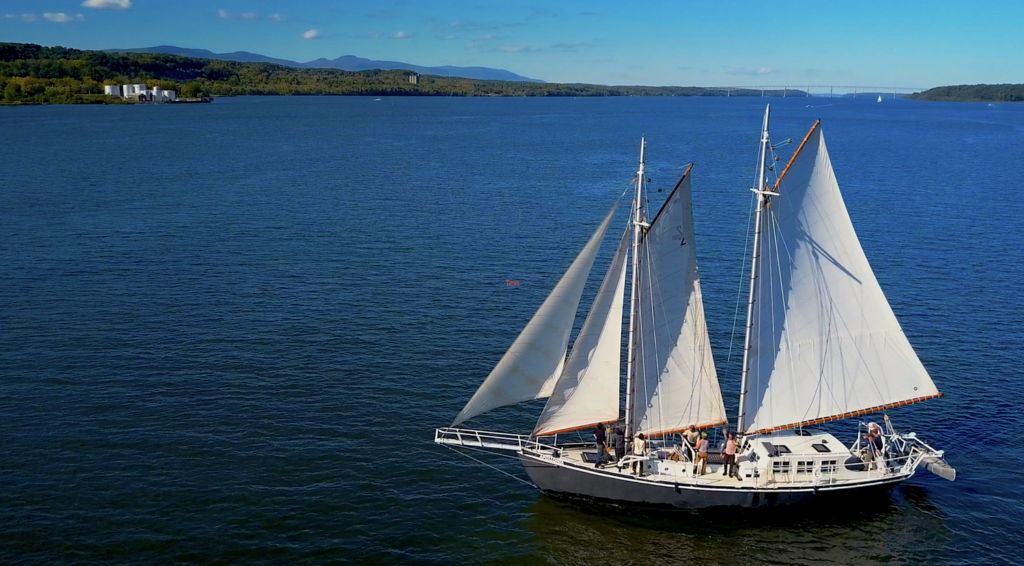
There is so much change in maritime recently that I have become very much interested in an experiment that is unfolding along the Hudson River that is working on the smallest scale. That project is called Apollonia. Apollonia is the experimental revival of sail freight along the Hudson River. Apollonia is a 64 feet 10 ton schooner operated by dedicated maritime experimentalists in an effort to shift cargoes from fossil fuel driven vessels and vehicles to sustainable energy driven vessels.
In the simplest terms, it is sail transportation along the Hudson. That is inherently slow and labor intensive, which would seem unattractive as compared to fossil fuel driven cargo transportation along the Hudson River.
However, that is a flawed comparison because today there is no cargo transportation along the Hudson River. There is some cargo transportation in and out of the Hudson River, but not along the Hudson River. There used to be massive cargo transportation along the Hudson River, but that has been taken over by trucks. There are trains that run along the Hudson River, but they do not distribute cargo along the river. While trains are also quite efficient, they have their own disadvantages such as being stuck to a fixed track.
Appollonia is doing cargo distribution along both sides of the Hudson River as far south as New Jersey and as far North as the start of the New York State Canals. This is a two-way neighborhood cargo distribution system that aims at zero emissions.
Apollonia is sail powered, which on the Hudson (actually named Mahicantuck; the river that flows both ways) means she is actually sail and tide powered. The typical average voyage speed with wind and tide is three knots, which is slow but also quite impressive for sail power and, if speed is not required, it is perfectly fine for cargo on boats that don’t burn any fuel.
So far, Apolonia has sailed 11 round trips with cargo from Hudson to New York City and has delivered 110,000 pounds of cargo on those trips. There is a wide variety of cargo, often quite small parcels, but real cargo all the same, such as malted barley for microbreweries, pumpkins, maple syrup, mushroom logs, beer, cider, solar panels, coffee beans, flour, honey, condiments and mead. Right now, there is more downriver cargo than upriver cargo, but that is just a matter of finding the right cargo to go upriver. For example, I would like to see my local Monmouth County elixer, Laird’s Applejack, carried upriver at zero emissions.
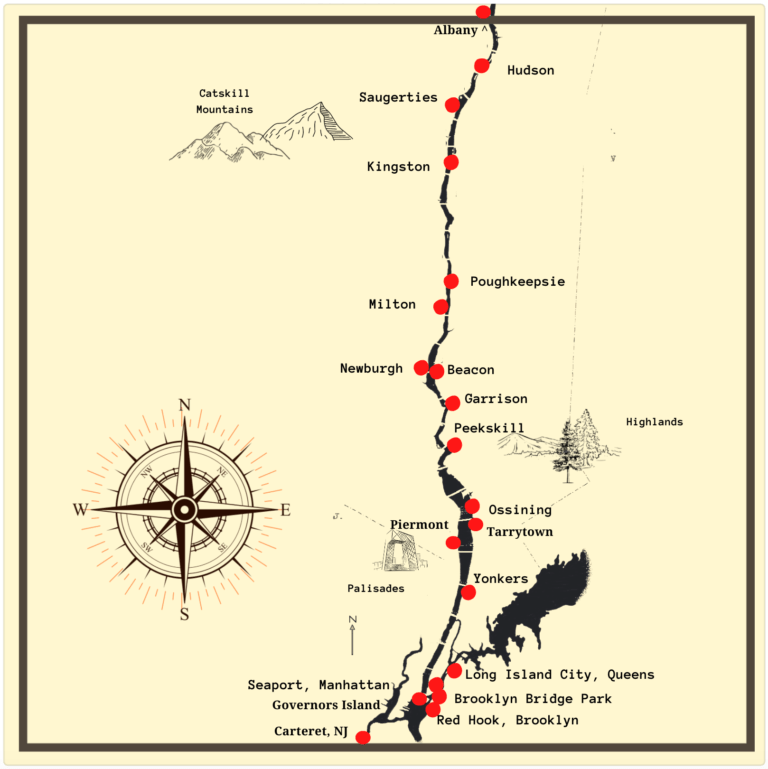
The vessel’s arrival at what is presently amounting to 20 different ports is becoming a community event and the focus of the repurposing of neglected community waterfronts to serve as recreational, commerce, tourism and educational hotspots. The community event character is growing into a waterfront market situation where the vessel is also selling cargo on the dock; a famous river trade tradition.
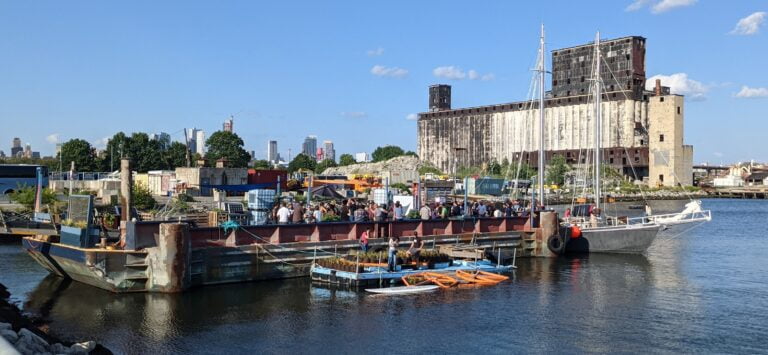
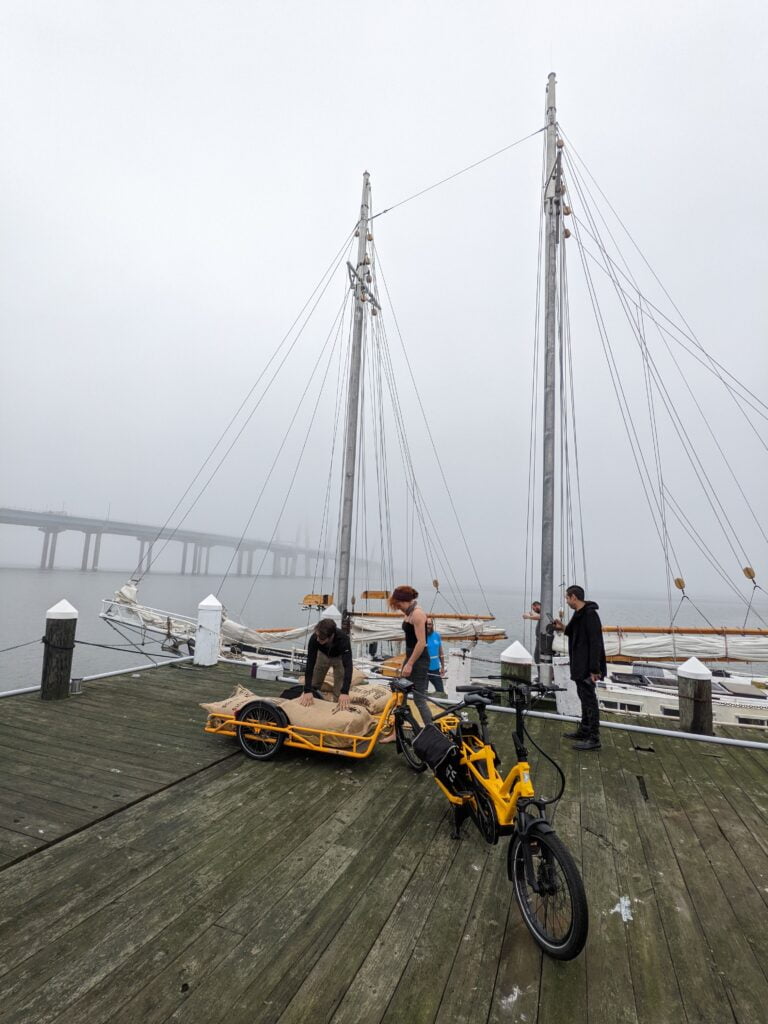
Unloading in Brooklyn
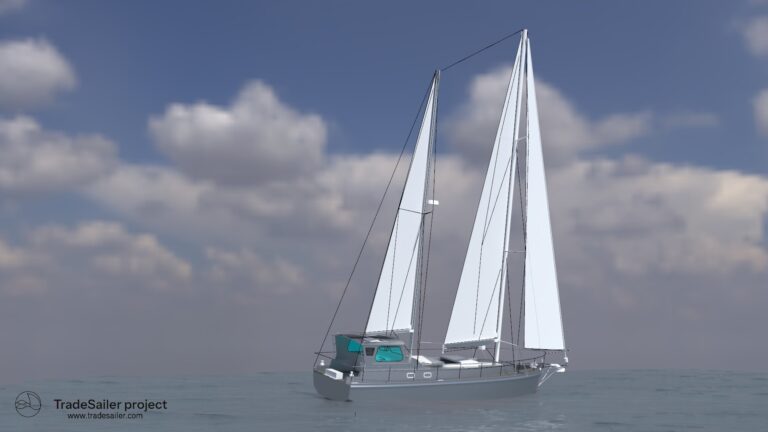
In its present guise, Apollonia uses a diesel engine to maneuver the vessel to the berth, but the crew is extremely parsimonious with the use of diesel and, at present, fuel consumption is 3 gallons for a 250+ mile voyage. She is actually an excellent candidate for solar powered electric drive to make the vessel zero carbon, and some design work in that regard is underway.
Moreover, the dedicated Apollonia team also focuses on zero emission door to door distribution, where they even carry a solar powered ebike and trailer, and will deliver cargo only to EV’s for further inland distribution.