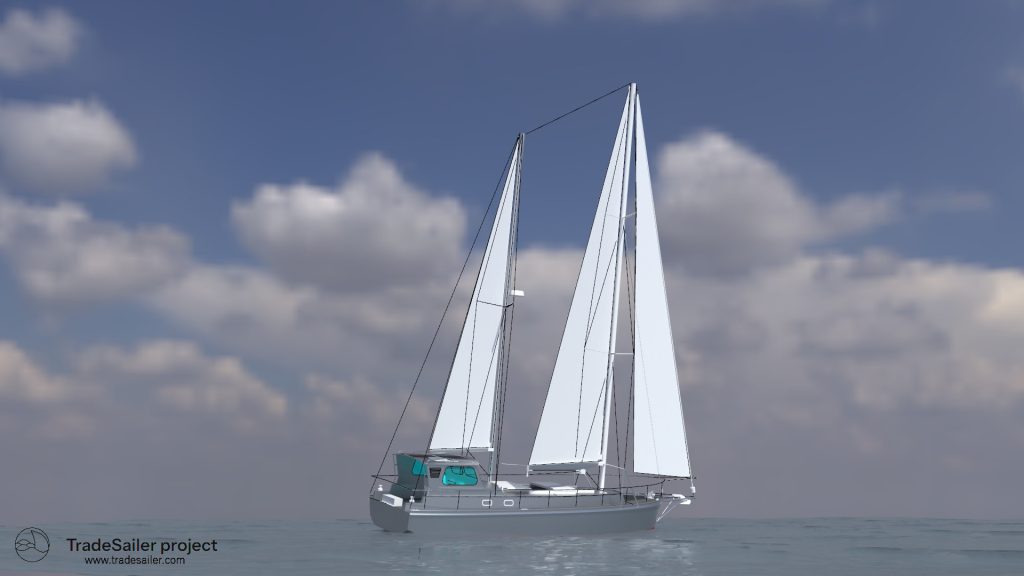
Sail Freight Is Getting a Practical Coastal Workhorse
A new collaboration aims to simplify launching low-carbon coastal shipping The future of coastal sail freight may arrive sooner than predicted. The Center for Post

A new collaboration aims to simplify launching low-carbon coastal shipping The future of coastal sail freight may arrive sooner than predicted. The Center for Post

Over the last two years the Center for Post Carbon Logistics, Inc. (CPCL) has
been working to develop regional near-zero emission maritime trade. Because of the
headwinds of policy and disappearing funding for anything climate related from the
federal government, we have pivoted to a strategy of seeking regional funding for a
fleet of near-zero emission ships working the waterways of the Northeast US.

By Rik van Hemmen, Vice President and Partner, MARTIN, OTTAWAY, van HEMMEN & DOLAN, INC., Originally published in Surveyors Notebook. © 2026 Martin, Ottaway, van

The Sail Freight Business Handbook has been designed to provide entrepreneurs and advocates with the fundamental business analysis and route identification tools to realize the Center’s goal of increasing year-round, near-zero-emission coastal maritime trade.

The Pallet Container has the potential to make sailing cargo vessels and bike deliveries economically superior to trucking while slashing congestion and pollution.


The moment is right for a rebirth and transformation of the American Merchant Marine — and it will start in New York.

INTRODUCTION Based in New York’s Hudson Valley, the Center for Post Carbon Logistics (the Center) is engaged in a long-running campaign to bring the idea

As a result of the Center’s mission and the recent RFEI from New York City regarding Maritime transport, it is appropriate that the Center respond

A tanker transiting the Strait of Hormuz was struck by an unknown projectile, leaving two crew members with minor injuries, the United Kingdom Maritime Trade Operations (UKMTO) said.Military authorities informed UKMTO on September 21, 2026,…

South Korea's steel sector could see trade revenue losses surge to over $1 billion by 2034 from only around $20 million in 2026 as the EU's Carbon Border Adjustment Mechanism (CBAM) exacerbates competitiveness pressures on Korean steelmakers.de restrictions.
Coal-fired power generation across the EU increased 45% year-on-year in August as soaring gas prices supported the fuel's use amid strong summer demand.

Trafigura has established Volare Shipping as a dedicated oil tanker owner with six Very Large Crude Carriers (VLCCs) operating and eight newbuilds on order, and plans to raise about $500 million before listing the company in Oslo.Volare's eight…

A new shuttling system is reshaping the Middle East oil market, as producers seek to keep exports flowing despite the escalating regional conflict. The question now is whether this complex, expensive process is a stopgap measure or the global…